 |
Tolstoy Loves Me by Brendan McKay |
|---|
Summary
I demonstrate a remarkable matching between my name and my date of birth in the Hebrew translation of War and Peace. A rigorous method of analysis produces a significance level of less than 1 in 5000. As supporting evidence, my place of residence is also shown to be remarkably well matched to my name.

Introduction
The first 78064 letters of War and Peace have been used as a standard control text since they were so-used in the paper of Witztum et al [WRR]. The length is taken to be the same as the length of the Koren edition of the Book of Genesis.Given two words w,w', a complicated procedure in [WRR] defines a "distance" c(w,w') in the range 0-1 (though sometimes it is "undefined"). To good approximation, random words w,w' will produce a value of c(w,w') uniformly distributed between 0 and 1. Also in [WRR] are several procedures by which a set of numbers in the interval [0,1] are converted into a single number in the same interval. These procedures are called P1 and and P2. P1 and P2 cannot be correctly interpretted as probabilities, but in [WRR] they are used as measures by which several different sets of numbers can be compared. Small values of P1 and P2 indicate "close matching", and large values indicate lack of matching.
Data
I will use the Michigan-Clairmont scheme for transliterating Hebrew letters. Here is the definition:) = Alef B = Beit G = Gimmel D = Dalet H = Hey W = Waw Z = Zain X = Chet + = Tet Y = Yud K = Kaf L = Lamed M = Mem N = Nun S = Samech ( = Ain P = Pey C = Tzadi Q = Kuf R = Reish $ = Shin T = TavMy name is Brendan McKay, which in Hebrew is most correctly written BRNDN MQYY. With regard to spellings, there is no question about BRNDN, as the final "a" of Brendan is not pronounced at all, and certainly is not "o" or "oo". The name McKay can conceivably be spelt in other ways, but the use of only one K or Q correctly reflects the pronunciation, which is not Mc'Kay but M'Kay. In any case, the spelling MQYY was the one independently chosen by the Israeli newspaper Maariv, on the single occasion that I have been named in the Israeli press (May 29, 1997).
My place of residence for the past 14 years has been Canberra, Australia. The Hebrew spellings of these names according to the Encyclopedia Hebraica are QNBRH and )WS+RLYH.
My date of birth was October 26, 1951. In the Jewish calendar, that was 26 Tishri 5712.
To perform the experiment, we must convert the data into words, limiting ourselves to the range 5-8 letters as in [WRR].
Firstly, following [WRR], we make a list of appellations. There are only two obvious ones: BRNDN and DR MQYY. Others are too long (BRNDN MQYY, DR BRNDN MQYY) or too short (MQYY). (The method of [WRR] requires 5-8 letters.) The use of DR for representing my title is common in Israel; for example it appears on office doors in university departments. I do not hold the rank of Professor according to the rules of my University, and so am not entitled to use appellations with that title.
To make the date 26 Tishri 5712 into words, we use precedents from earlier experiments. Firstly, we follow [WRR] in writing 26 Tishri as KWT$RY, BKWT$RY and KWBT$RY. Secondly, we follow [HNGM] in writing 5712 as BT$YB, HT$YB, BHT$YB, $NTT$YB, B$NTT$YB, and $NTHT$YB. (The other two, T$YB and B$NTHT$YB are outside the 5-8 length range.)
Distances
When the procedure c(w,w') from [WRR] is applied, a considerable number of small distances are found.
         w =  BRNDN    DR MQYY
    w'

  KWT$RY     0.1120    0.0480
  BKWT$RY    0.2542    0.1441
  KWBT$RY    0.1557    0.1393

  BT$YB      0.3200    0.4160
  HT$YB      0.0720    0.0160
  BHT$YB     0.0240    0.0720
  $NTT$YB    0.1368    0.0211
  B$NTT$YB   undef     undef
  $NTHT$YB   0.7500    0.8750

  QNBRH      0.0880    0.0081
  )WS+RLYH   undef     undef
Values marked "undef" are undefined according to the rules of [WRR].
Significance Levels
The procedure from [WRR] cannot be used because there is only one personality (myself) in the experiment. Therefore we must devise another way to determine how unlikely it is to obtain so many small values. In all cases we will use the measures P1 and P2. Because the place of residence is somewhat different in nature from the date, we will perform all tests twice: once with only the date, and once with date and place combined.The values of P1 and P2 are:
            Date only    Date and Place

    P1 :    0.0000326     0.00000252
    P2 :    0.0002415     0.00001971
The first method of obtaining a significance level will be to
try alternates to the two appellations, namely rearrangements
of the letters. For example, instead of BRNDN we try BNNDR,
NDBRN etc.. This approach was used in [M] to analyse the
famous Aaron cluster.
Since the calculation of c(w,w') uses words running both forwards and backwards, and each appellations contains one letter twice, there are 30 distinct permutations of BRNDN and 180 of DRMQYY. In combination, there are 30*180 = 5400 distinct pairs of appellations. We tried every one of these appellation pairs and calculated the P1 and P2 scores. Here are the results:
- Using the date only
                                            P1          P2

  Best:                BRNDN, DRMQYY    0.0000326    0.0002415
  Next best:           DBRNN, DRMQYY    0.0002476    0.0008575
  Best derangement:    DBRNN, RDQYMY    0.0070036    0.0030297
The correct spelling wins by a factor of 7.6 for P1, and by a factor of 3.6 for P2. The third line shows the best combination of two misspellings. It is worse by a factor of 215 for P1, and a factor of 12.5 for P2. - Using both the date and the place
                                            P1          P2

  Best:                BRNDN, DRMQYY    0.0000025    0.0000197
  Next best:           BRNDN, RYQDMY    0.0000224    0.0000767
  Best derangement:    BDRNN, RYQDMY    0.0009109    0.0006115
The correct spelling wins by a factor of 9.0 for P1, and by a factor of 3.9 for P2. The third line shows the best combination of two misspellings. It is worse by a factor of 364 for P1, and a factor of 31 for P2.
A Confirmatory Computation
In order to demonstrate that the remarkably low significance level computed in the previous section is not too much an artifact of the computational method, we also tried another approach. Keeping the spellings constant, we randomly permuted the letters of War and Peace. We did that 10,000 times, and for each text we computed the P1 and P2 scores. Here are the numbers of texts, out of 10,000, performing better than the real text of War and Peace:
  Using the date only      Using both date and place

    P1       P2                  P1       P2

    4        9                   2        2
Here again we see consistent significance levels below 1 in
1000, completely confirming our expectations.
What am I Claiming?
The lesson to be drawn from this paper is clear enough. Anyone with the skill and the perseverance can make ELS experiments that seem to show remarkable results. In this paper we found a significance level well below 1/1000 from a single name and a single date.Did it happen by chance? Yes!
References
[WRR] D. Witztum, E. Rips and Y. Rosenberg, Equidistant Letter Sequences in the Book of Genesis, Statistical Science, Vol 9 (1994) 429-438.[M] D. Michaelson, Reading the Torah at Equal Intervals, B'Or Torah, 1987.
[HNGM] D. Bar-Natan, A. Gindis, A. Levitan and B. McKay, Report on new ELS tests of Torah, 1997, here.
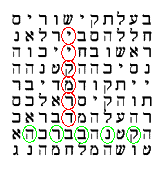
The image at the top of the page shows "Canberra" and
"Dr McKay".
Back to the Mathematical Miracles page
Copyright Brendan McKay (1997),
[email protected].
Overview on numerical features in different scriptures
Answering Islam Home Page