|
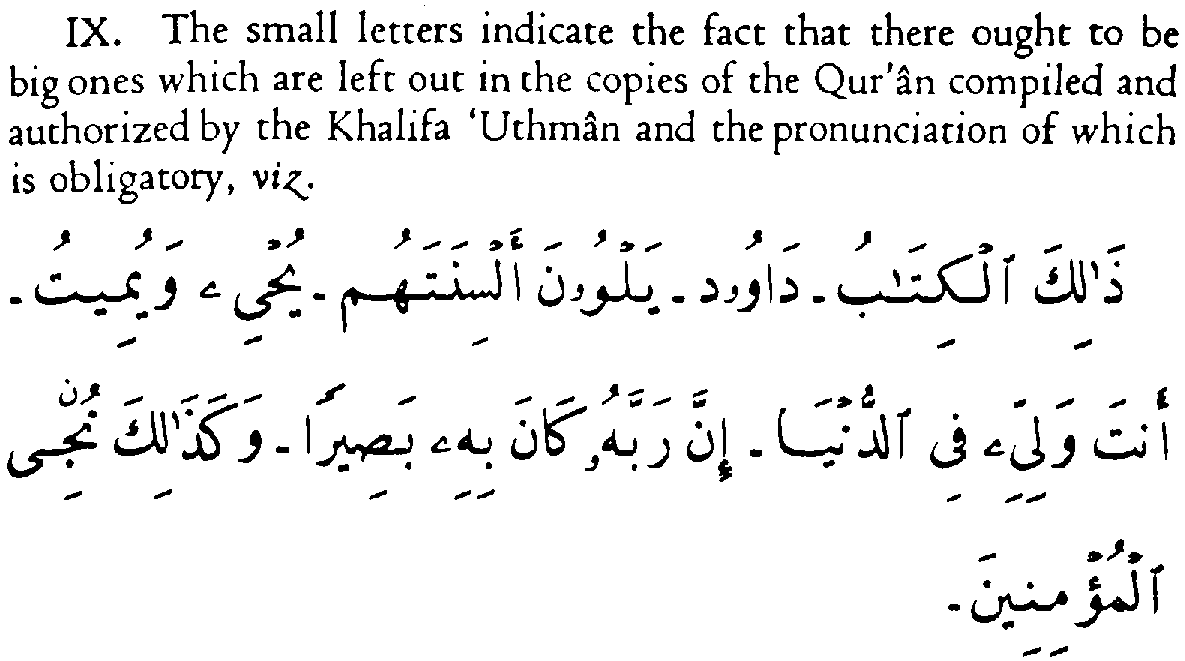
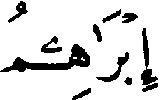
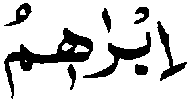
Part 2: The True State Of The Qur'an Back To Main Index h/ Other Consonants Missing Or Added - Yas, Waws & Nuns As we proceed with these topics we begin to see more clearly the purpose of the content of the Note IX of the 1938 Hyderabad text31 which we reproduce again here [see to right]. We begin by noting what Hamidullah has written concerning Egypts contribution to what he calls "the profuse markings of pronunciation (irab) in the usual copies of the Quran". Under the heading "Egypts share in the development of Arabic script" he notes: "In recent years, especially in Egypt, some new signs have been added to the list, in order to facilitate the marking of the assimilation of sounds and other subtleties of the Arabic phonetics." (Orthographical..., p. 76) The Notes, then, were necessary since in 1938 Pickthalls text was printed alongside an Arabic text almost identical to32 the 1924 Royal Cairo Edition which contained Egypts "new features". The Notes were thus intended to orient people to certain new features, many of which had never been seen in a text in India before33. We have already noted the dagger alif which Hamidullah listed and which is also included in this Note. It should not surprise us, then, to find that the other examples in this Note are also admitted by M. Hamidullah and included in his list of yas, waws and nuns omitted from the Uthmanic texts. 1/ yas omitted Yet there are also words without yas of which Hamidullah says: "It is not written in the [case of] which occur altogether 69 times and could be written  . . The case of the word ( 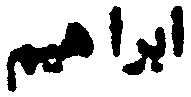 ) is curious: in the Quran it is written sometimes ) is curious: in the Quran it is written sometimes  and other times even and other times even  . In these cases a small ee is supplied as a sign of vocalisation for the help of the reader." (Orthographical..., p.78f, emphasis added)34. . In these cases a small ee is supplied as a sign of vocalisation for the help of the reader." (Orthographical..., p.78f, emphasis added)34.
Again, it should not be called curious that any word, let alone the name Ibrahim (Abraham), is spelled in two different ways, but NOT EVER in the right way which requires another alif ( 151 |

|
Part 2: The True State Of The Qur'an Back To Part 2 Index recognise these corrections by both the small yas and small alifs which have been written above the text in, say Q2:126, in the 1924 Egyptian text One other example of a missing ya as given by Hamidullah is Q7:196. In his List B he indicates that a corrected version would have an extra ya, But, we note the 1924 Egyptian has placed the shadda above the small ya to indicate that in fact 2 yas were missing from Uthmans graphic form - or is it that 2 yas were added by the new reading, or...? On the other hand, the fact that the Warsh text contains a second ya in the graphic form just after the first ( But perhaps the Warshs ya in Q7:196 is indicative that it has been corrected. We say this because in Q106:1, 2 noted earlier, one finds the Warsh text with this very ya in the graphic form However, we noted the 1924 Egyptian Hafs text has added a small yain the same line as the graphic form, not above it In terms of the original texts, according to the 1924 Egyptian Edition this word was spelled correctly in one aya (Q106:1), and incorrectly in the next Yet again, we are confronted with the Oral Tradition declaring that 152 |
 whereas the Pakistani Taj uses the short vertical stroke underneath
  to indicate "something is missing here!". The Warsh (Medinan) text was written correctly, with ya
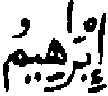 but is also without the alif.
  . This is what the Turkish
 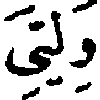 (and Iranian
 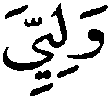 ) graphic form is like. Yet, when we look at the Egyptian text it has a small ya above the text
 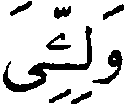 thus indicating another reason why the Egyptians had to reject the Turkish text - to re-instate the errors.
 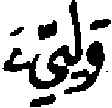 ), actually raises our suspicions, for it doesnt match the corrected graphic form of, for example, the Iranian text which joined everything together
 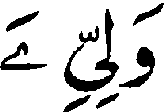 as also the Indian
 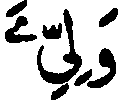 both showing signs of the Warsh graphic form35, indicating once again that they are a mixture of the Warsh (Medinan) and Hafs (Kufan) graphic forms.
 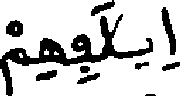 despite ad-Danis declaration that the ya in Q106:2 was missing from all the Uthmanic manuscripts!
 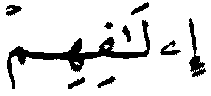 but which is obviously meant to replace the missing ya. However, all the texts have the same word spelled correctly in Q106:1
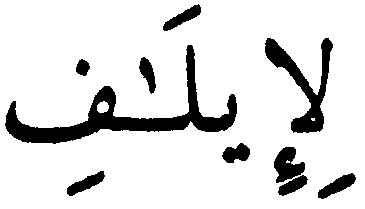 .
.  .
. |
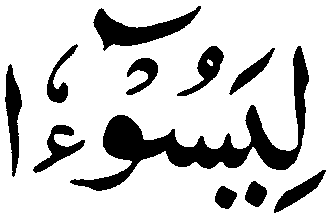
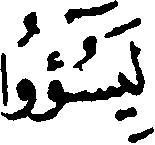
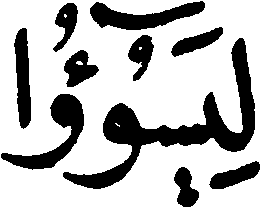
Part 2: The True State Of The Qur'an Back To Part 2 Index only 6 of the 7 Readers read this with ya: "According to ibn Mujahid, this reading was read by six out of "the seven" - ibn Katir, Nafi, abu Amr, Hamza, al-Kisai, and Hafs an Asim. (Dayf, p. 698.9)." (Studies..., Ph.D., Brockett, p.234) In other words, this ya is part of the vocal form, not because it was a scribal error which was being replaced, but because 6 of the 7 Readers had added it in their reading of the text! Where it is in the graphic form, it is a case of someone "adding to" the Uthmanic text. Since many more such small yas exist among the graphic forms of both texts, we must ask how many of them have originated in just such a fashion?! 2/ Waws Missing But there are also words with waws missing, for Hamidullah admits: "Again, in certain cases the letter is lacking, although in logic it ought to have been written. For instance the words36. In modern Qurans a very small (  ) is added just after the first one in order to distinguish it from the text, as if the second were a sign of vocalization and not a letter of the alphabet." (Orthographical..., p.78; emphasis added). ) is added just after the first one in order to distinguish it from the text, as if the second were a sign of vocalization and not a letter of the alphabet." (Orthographical..., p.78; emphasis added).
Hamidullah's assertion that the spelling is illogical is an upholding of ibn Khaldun's conclusion. As to the corrections, the texts differ. The second example Hamidullah records in his List B under Q43:13 where we find The 1924 Egyptian Edition has this small waw to replace the missing consonant Concerning Hamidullah's other example, we find it in his List B under Q17:7, where he gives a spelling in which the small waw is after the other one Contrary to this, in the 1924 Egyptian Edition we find a small waw above the word in It would appear that all these recognise that had they followed Hamidullah's corrected graphic form they would have to manipulate it to give the right sound. For some reason, Hamidullah has chosen to agree with the graphic form of the Turkish In Q70:10 (vs. 13 in the Egyptian) the Turks have a red waw These are the same type of replacement as the ya just mentioned in 153 |
 and
and  require to be written
  and
and 
 .
. 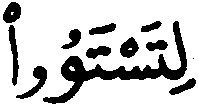 ; as does the Turkish (in red ink)
 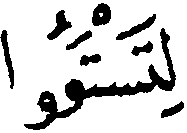 ; and the Warsh
 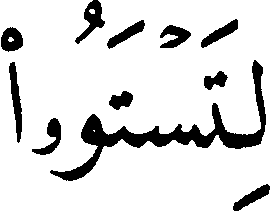 . The Taj, however, has its own form of correction
 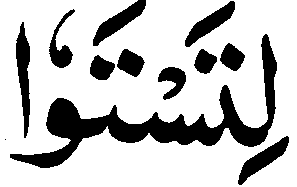 .
.  .
. 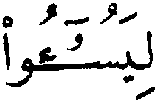 but under the word in the Warsh
 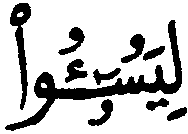 although also issued by al-Azhar. The Taj (and Indian) text has
  .
.  and Iranian
  texts.
 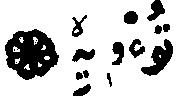 which the Egyptians have omitted from their Edition
 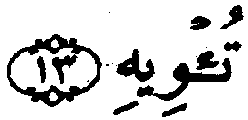 .
. |
Part 2: The True State Of The Qur'an Back To Part 2 Index Q106:2. We note that Hamidullah emphasises that these are only made to appear to be vocal when he says "as if the second were a sign of vocalisation and not a letter of the alphabet." Indeed, as with many other signs in the Quran, they are false vocalisations, things that are "made to appear" to be vocalisations when they are in fact replacement letters of the alphabet. Hamidullah makes an extremely important point here. But, not all these added letters of the alphabet can be found in both the Medinan (Warsh) and Kufan (Hafs) texts. This again shows that the text AS IT IS was quite acceptable to some who used it in their new reading. Others chose to go beyond the Uthmanic text in their new readings. Since it is the Islamic school of thought concerning the Arabic of the text of the Quran which we are examining, and not some other, every such addition indicates the need to do something to make the original text perfect. The theology, on the other hand, teaches that it was already perfect because it had a Divine origin and was perfectly transmitted from Allah to Jibreel to Muhammad - and from Muhammad to others, etc.. 3/ Nuns Missing/ Added (a) Another feature mentioned in the 1938s Note IX and also raised by Hamidullah is that of a consonant nun missing in Q21:88. It is depicted in the Note IX just cited, at the left end of the bottom line, namely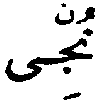 (the word nUnji is formed by correcting through false vocalisation). (the word nUnji is formed by correcting through false vocalisation).
Hamidullah too writes of this. After writing about the extra consonant ya in biyyadin, he writes of what he terms this "one case" of a consonant missing in the Quran (!): "In consonants also there is a case, but just the contrary one; the Quranic orthography In the 1924 Egyptian text one finds only a small nun above the graphic form 154 |
 is for what one would expect
  ; and the want is supplied by an additional but small (
 ) as a vocalisation sign." (Orthographical..., p. 79; emphasis added)
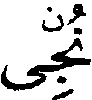 , while the Taj text (as in the Swahili) from Karachi includes a sukun above the nun
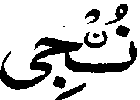 .37 However, as the following indicate, the Turkish
  , Iranian
 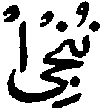 and Indian
  texts ALL correct the error by inserting this nun into the graphic form. Here is yet another reason the Egyptians had to reject the Turkish text. We note that the Warsh also has
  indicating that this nun was included in the Medinan manuscript.
 |
Part 2: The True State Of The Qur'an Back To Part 2 Index (b) Yet there seem also to be more methods of expanding the text to create another nun, for, concerning Q12:11 we find that Note XI in the 1938 Hyderabad text reads:
However, whereas this Note XI shows The dot for identifying the nun and the shadda above it have been shifted off the existing stem, into the empty space beside it, and a At first glance one is unable to understand why the scholars of Islam didnt simply add another consonant nun in the same way as it has in Q21:88. However, when one examines the Warsh text and finds The Warsh reading of So, as with the dagger alifs, yas, and waws, again we find Islam adding nuns, not as corrections because of scribal errors, but because the reading went beyond the Uthmanic graphic forms. All this is clear Proof that the existing texts are a mixture of various 155 |

 , the actual printing of Q12:11 in the main Arabic text agrees with the 1924 Egyptian Edition and is
  . In both
  and
and  [diamond] has been added just after the now vacant stem! Its purpose is perhaps to subtly draw attention away from the intrusion of the diamond which indicates that a 3rd nun is being introduced to a text that has only one! The diamond is thus "made to appear" to be seated on the stem!
 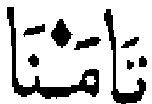 indicating that the Uthmanic text has been used as is38, one realises that it is the reading of Hafs which has demanded that Islam stretches the single nun to 3 nuns! It cant do this with only one shadda and to add a non-existing original would, as we have seen, bring a conflict between the vocal form and the text (!), so Islam had to devise a method whereby it could accept this new reading - which it assures us is among its "best transmitted and most reliable" and is almost close to the Uthmanic text!! This is the Hafs reading, the most widely used reading in Islam! Brockett notes the reading with 3 nuns as tamannna39.
 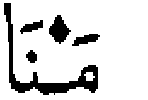 is to be found also in the Turkish
  Iranian
  Indian
  and Pakistani Taj (as in the Swahili)
  texts, even the 1975 Islamic Foundation (83 Amana) text omits the little diamond sign
  40 , thus agreeing with the Warsh reading ( 2 nuns) instead of the Hafs reading (3 nuns). In agreement with this, our Indian transliteration reads
  , showing the 2 nuns of that text.
 |
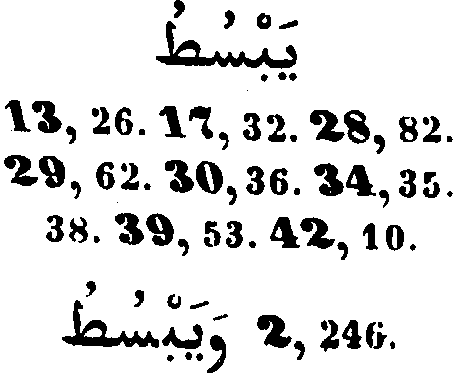
Part 2: The True State Of The Qur'an Back To Part 2 Index of readings and many tamperings. And, so we find another reason for the Egyptians to issue a new EDITION of the Arabic text! i/ Sins Missing - "Allahs Wisdom" In each of Q2:245 and Q7:69 there is a small sin present above most texts, again as a vocal sign, meant to guide the reader to pronounce the sad which is in the graphic form as if it had been written correctly, as a sin 41!! Hamidullah does not mention these, for obvious reasons. In Q2:245 42 the Egyptian text has the word yabsutu spelled with sad The Flugel concordance [p. 29. seen at right - his numbering is from a different system and often the exact verse numbering is off by one or two]
lists only the corrected spelling of yabsutu Q13:26 17:30 28:82 29:62 30:37 34:36 34:39 39:52 42:12 to say nothing of the many other times that variations of the same word occur. A letter for letter (complete) examination of several Arabic texts also indicates this. Flugel also lists only 2 occurrences of the word bastatan, A 1797 text from Istanbul has corrected both Q2:245 The Samarqand original [Page #367, line #7 which can be seen at right]
also contains the correct spelling in Q7:69 as we saw earlier in our comparison with the 1924 Egyptian Edition. 156 |
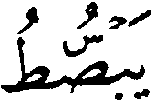 indicating that the original graphic form of Kufah had a sad in the text. However, the Iranian text has replaced the graphic sad in Q2:245 with the sin
 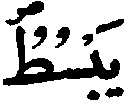 .
. 
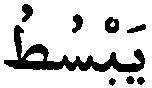 in Q2:245. His documentation reflects the fact that the same word is spelled correctly in
 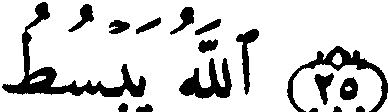 ;
; 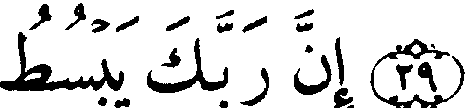 ;
;  ;
; 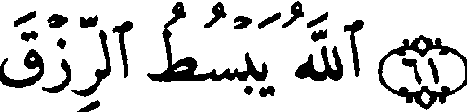 ;
;  ;
;  ;
; 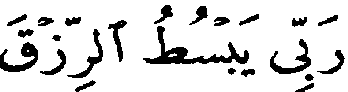 ;
; 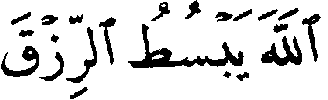 ;
; 
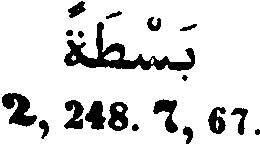 in Q2:247 43 and in Q7:69. He spells both with sin. In the 1924 Egyptian we find
 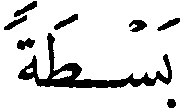 in Q2:247, but in Q7:69 as mentioned, we find the small vocal sin above the sad
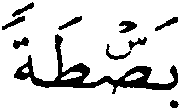 .
. 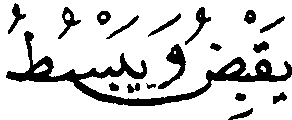 and Q7:69
 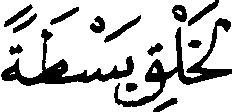 , thus concurring that these are spelling mistakes.
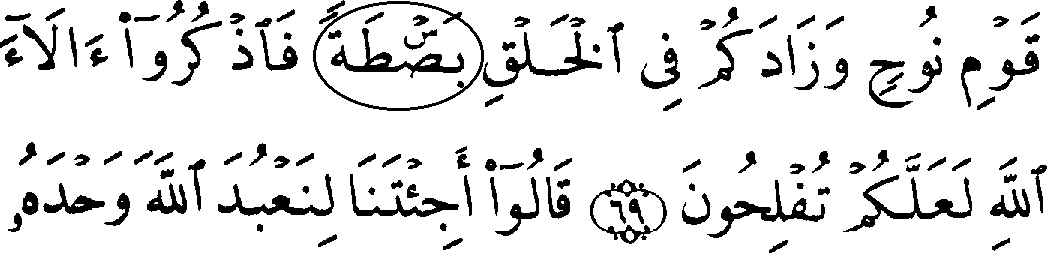
|
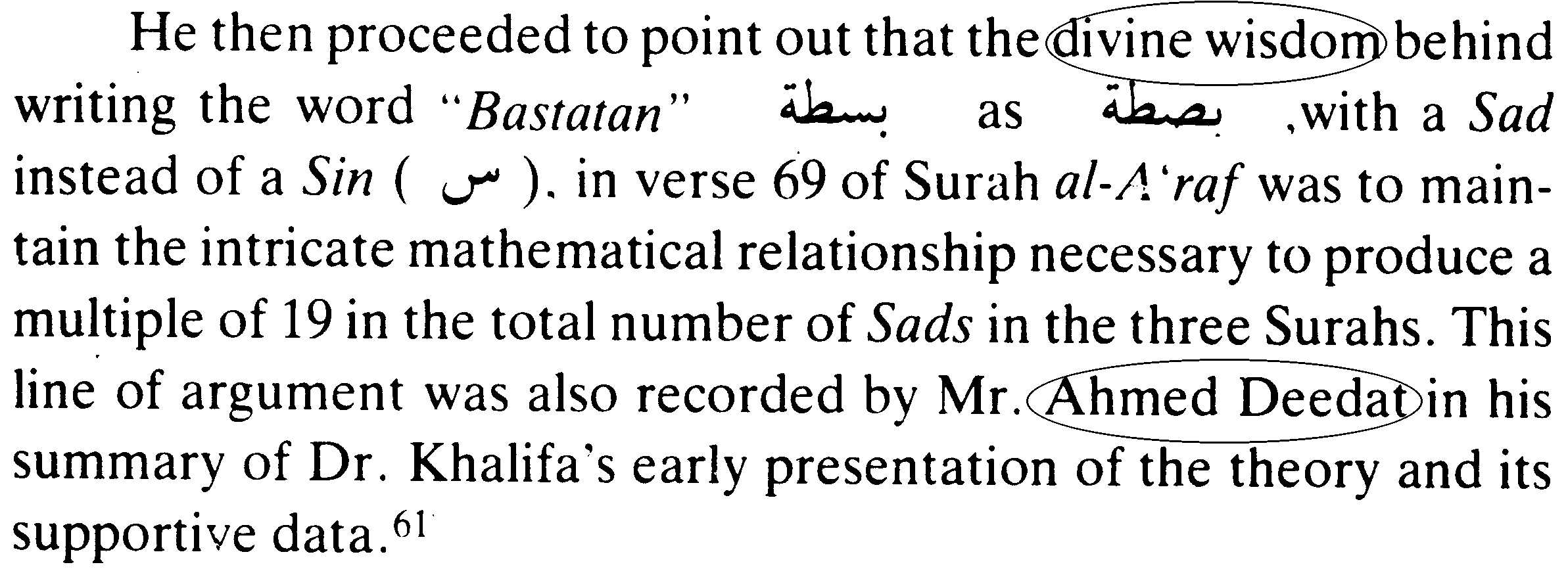
Part 2: The True State Of The Qur'an Back To Part 2 Index [The page of the Samarqand MSS with the text of Q2:245 is one of those missing.] Finally, the Warsh text has no small sin above the sad in either Q2:245 or Q7:69. Strangely the Islamic mind can attribute the mistakes in the graphic form to Divine Wisdom. As Bilal Philips (#19, p. 23) recounts when noting this very same text from Dr. Khalifahs writings (circles are added):
Here we find that Mr. Deedat has been admitting the Divine Wisdom behind the textual faults of the Quran! All this he recorded in, of all things, his booklet entitled "Al-Quran: The Ultimate Miracle"!!44 And, even more amazing, is that the Saudis gave him the "King Faisal Award" for his "outstanding services" to Islam for all this!! AMAZING!! Bravo, Mr. Deedat! Yet many still continue in this line of thought today (1999). For example, examine the following from the Internet: "Mr. Lomax of course would not understand the truth about the spelling of the word "BESM" that is written in three letters in verse 1 of Sura 1 (Basmallah) which makes the number of the letters in Basmallah 19 while it is written in 4 letters in other parts of the Quran e.g. 96:1 and 56:74 There cannot be 114 (19X6) misspelled (Besm) in the Quran. ( this is how many Basmalah (sic) are in the Quran despite the absence of Basmallah from Sura 9). God does not misspell words. He created them. Mr Lomax cannot and will not apprecite (sic) Gods miracle or get close to it until he believes God when He said repeatedly, that the Quran is complete and all that we need for our slavation (sic). God will not change people until they change what is in their heart. These words are not incidently misspelled, but deliberately written by the direction of God who told us that He in charge of writing the Quran, see 75:17. Do not just sit there and listen to the misguided views of other peole (sic), you still have to do your part and study it for yourself. 17:36 http://www.submission.org/miracle/" (Re :The 19 phenomenon: http://x21.deja.com/getdoc.xp?AN=528591262&CONTEXT=938986439.927334445&hitnum=0) To a people who believe it is "Allahs Wisdom" and his prerogative to 157 |
|
Part 2: The True State Of The Qur'an Back To Part 2 Index make spelling mistakes in a "perfect" Quran45, it is no wonder they can also accept and print the corrupted Uthmanic texts and convince the people that the mistakes in them are also Divine. As for those who come to recognise that the 19 theory isnt workable, the following question and hesitant answer shows that some recognise the problem which ensues if Allah didnt make deliberate spelling mistakes in the perfect Quran [For those not familiar with Internet discussions groups, remember the sentence behind the is a portion of someone elses message , and what follows is a response to it.]: "If the 19 is now gone with the time, is there an understanding of words in Quran being deliberately misspelled? Yes, as I have explained above. They deliberately follow the transmitted spelling, knowing that it is supposedly a mispelling (sic) and that it accords neither with its transmitted pronunciation nor with the grammatical derivation of the word from its root bsT." (Internet posting, soc.religion.islam; Re: On the 19 phenomenon, Sept 9, 1999; URL not available) Indeed one can only describe them as "deliberately misspelled" IF one ignores the fact that Muhammads scribes made the original errors and concentrates on the deliberate copying of these errors by others! "50,000 Errors" In The Quran? However, the conclusion a rational mind comes to is that it was not Divine Wisdom, but rather that indeed - aside from new readings not fitting - the scribes of Muhammad did not know how to write well, and many, many times not only made fatal errors, but throughout the entire text left Proof of what ibn Khaldun concluded was their backwardness in the things such as writing. We can take ibn Khaldun at his word that "Most of the letters were in contradiction to the orthography required by a person versed in the craft of writing". They didnt realise that a graphic consonant was required, and instead they thought it was something that was unwritten (vocal), and vice versa. In all cases it has fallen upon the later followers of Islam to deal with such by inserting waws, yas, alifs, lams, nuns and sins, etc. whether vocal or graphic - into the tens of thousands. Perhaps originally there were 50,000 errors in the Quran? Back To Part 2 Index 158 |