
Appendix B: MOUNTAINS OF SPICES
Below are a list of spices and their descriptions used in the preparation of the bride.

MYRRH: OBEDIENCE UNTO DEATH
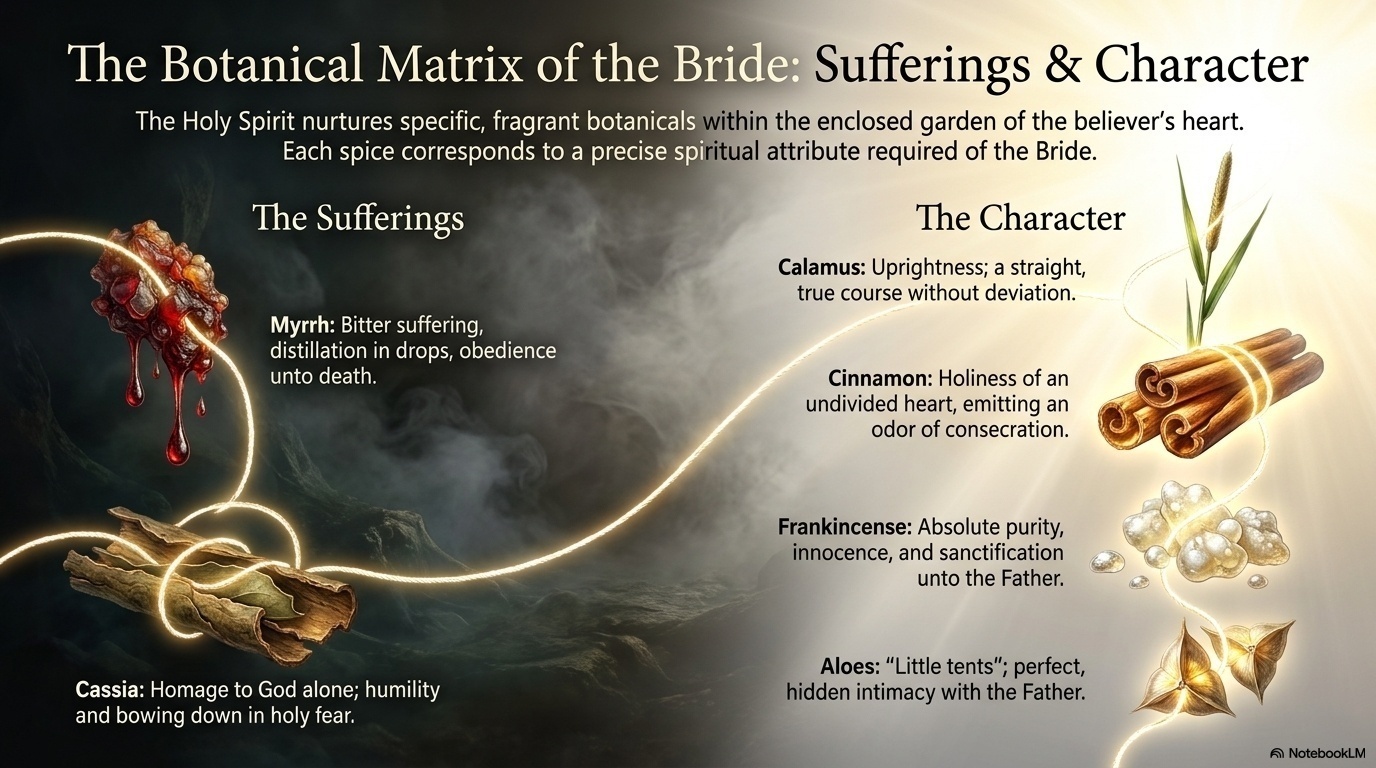
The spice myrrh comes from a thick gum that flows from the pierced bark of a knotted, thorny tree. The gum hardens into red drops called “tears.”The word myrrh comes from a primary root in Hebrew meaning “bitter suffering.” It represents the bitter sufferings of Jesus as a man on Earth.
The Greek word denotes a spice used in burial. In the New Testament, the Magi brought gifts to the Christ child, including myrrh, a foreshadowing of His suffering and bitter death on the cross (Matthew 2:11).
The original sense of the word is that of “distilling in drops”—a slow process of purification. Christ lived a life of distillation, for “although He was a Son, He learned obedience from the things which He suffered” (Hebrews 5:8). Jesus emptied Himself of His own will, and this culminated in obedience to the point of death on a cross (Philippians 2:7—8). Likewise, each child of God is called to smell of the myrrh of distillation day after day by denying his or her own self life and walking in obedience to the will of Christ alone (Matthew 16:24—25; 6:10).
CINNAMON: HOLINESS OF HEART
The primary root of the word cinnamon means “emitting an odor.”The spice is harvested in quills of the fragrant, inner bark of a tree of the laurel family.
In the Song of Solomon, cinnamon grows in the locked garden that Jesus says is “my sister, my bride” (Song of Sol. 4:12—14). The new heart of each believer is a garden with fragrant spices—a heart enclosed and set apart for the Lord Jesus alone—as the heart of Jesus is undivided in His consecration unto the Father alone (2 Chronicles 16:9; Luke 10:22).
In Proverbs 7:10, the adulterous woman, “dressed as a harlot and cunning of heart, has sprinkled her bed with fragrant spices that also include cinnamon (Proverbs 7:17), a counterfeit of the heart of the bride. She flings her heart open to embrace every sort of spiritual adultery.
In both instances, cinnamon emits an odor: either of consecration in holiness unto the Lord (Leviticus 8:12), which is sweet in the nostrils of God, or the corrupted odor of deception and seduction (Proverbs 7:17— 19), which is a stench to Him.
Cinnamon is one of the spices in the holy anointing oil that was used to set apart people and things as holy for God’s use alone (Exodus 30:23—25, 30). Jesus and those in Him are priests who are “holy to the LORD” (Exodus 28:36).
CASSIA: HOMAGE TO GOD ALONE
Cassia is also from the laurel family, smelling and tasting somewhat like cinnamon but considered inferior to it, a humbler plant. God exalts this lowly tree to provide one of the four spices used in the holy anointing oil (Exodus 30:23—25). Its name, representative of its properties, comes from a root word meaning “to bow down,” “to stoop,” “to pay homage,” depicting the humility of Christ before His Father. Jesus said, “I honor My Father…I do not seek My glory” (John 8:49—50). Although as believers we are to show ourselves humble before others (I Peter 2:17; 5:5), we are to bow down in worship to God alone (2 Kings 17:35—36; Matthew 4:10).
The word homage means “to show a reverential fidelity and respect” (Exodus 34:8). We, like Jesus, are to reverence our Father with holy fear and veneration, treating Him as sacred in the sight of others (Numbers 20:10—12; Ezekiel 36:22—23) and in the depths of our hearts (I Peter 3:15).
CALAMUS: UPRIGHTNESS
Calamus is a fragrant oil derived from a marsh plant known as sweet flag. The Hebrew word for this spice means “a stalk or a reed (as erect),” or upright. We see a biblical meaning of upright in the first instance of that Hebrew word in Scripture, being translated “right in [God’s] sight” (Exodus 15:26). God’s poetic name for His people Israel was “Jeshurun,” a word meaning “upright one” (Isaiah 44:2). In His Father’s eyes the Lord Jesus was upright in Himself (Psalms 25:8), in His words (Psalms 33:4), and in His ways (Isaiah 11:4).
The second biblical meaning of upright includes also that of being smooth and straight, that is, without deviation, a true and direct course. Everything about Jesus Christ is in true alignment with who the Father is. There is no obstruction or unevenness in Him to hinder the clear revelation of God (John 5:30; 14:9). Christians, like John the Baptist, are to “make straight the way of the Lord” (John 1:23), so that God’s Son may be seen and heard through them without any obstacle of their “flesh” (Romans 7:25; Galatians 6:8). Isaiah cried, “O Upright One, make the path of the righteous level” (Isaiah 26:7), so that their walk is straight toward God. Christ alone is upright or righteous in the Father’s eyes, and we in Him (2 Corinthians 5:21; Romans 10:3—4).
HENNA: FORGIVENESS
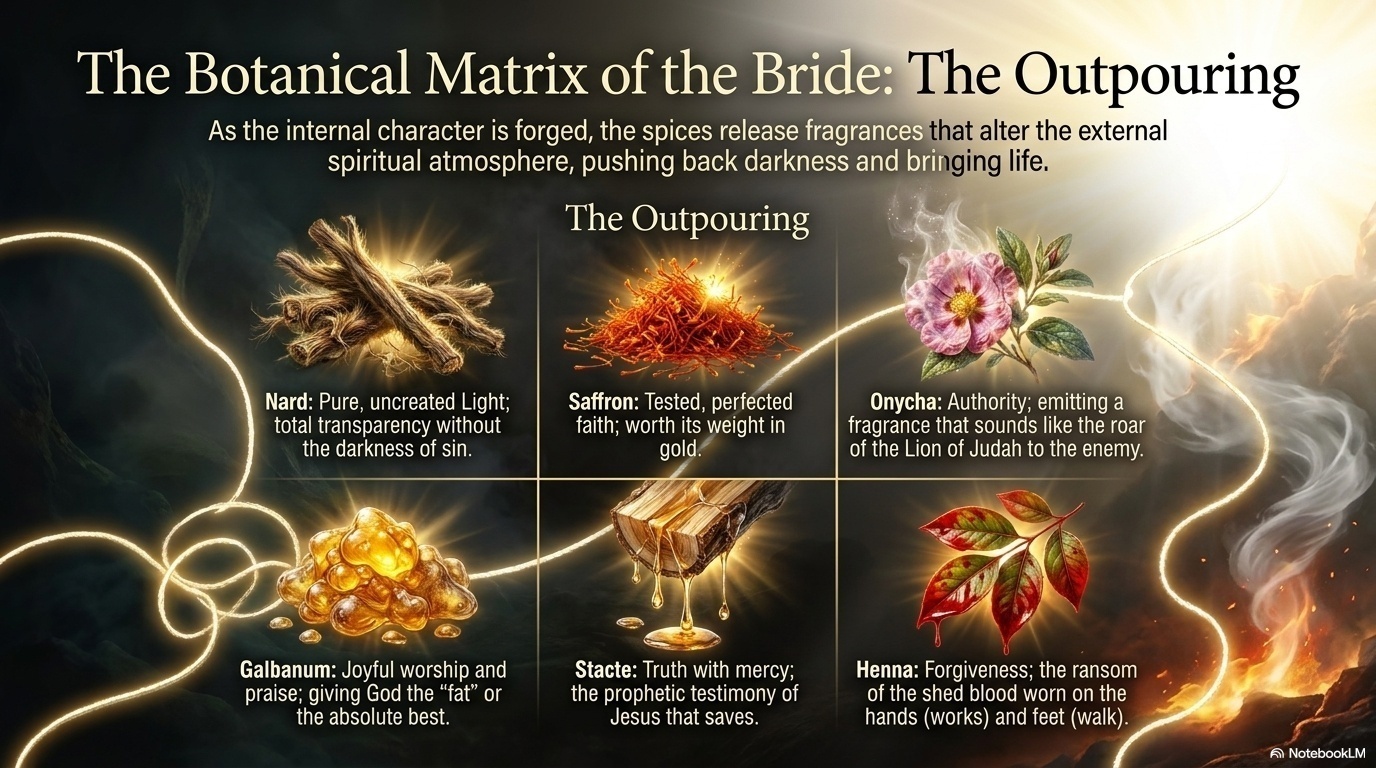
Henna, translated “camphire” in the King James Version, comes from a tree whose leaves yield a stain used as a red dye. The Hebrew word means “to cover, a redemption price, a ransom.” The primary root of the word means “to forgive” (Song of Sol. 4:13; Isaiah 43:3). Therefore this fragrant spice signifies the shed blood of Christ on Calvary as our ransom from sin and death (I Timothy 2:6).
In the Middle East on the night before a wedding, the bride has henna paste bound to the palms of her hands and soles of her feet. In Christian symbolism her hands (works) and feet (walk) are to exude the sweet smell of forgiveness and show forth the red stain of His shed blood on the cross. Christ calls His bride to walk continually cleansed through the forgiveness won for her by her Bridegroom (I John 1:9) and to pass that forgiveness on to others (Matthew 6:14—15).
ALOES: INTIMACY
The word aloes is from an Arabic word meaning “little tents,” descriptive of the three-cornered shape of the capsules of the lignaloes tree whose resin is fragrant.
The small, pointed tent is the type spoken of in 2 Samuel 16:22, meaning a “pleasure tent on the housetop” or a “bridal tent”: a place of intimacy. Outside the camp Moses pitched a private tent of meeting where God spoke to him face to face (Exodus 33:7, 9, 11). David also erected such a tent on Mount Zion for the ark of the covenant, where he could be as close as possible to the presence of the Lord (2 Samuel 6:17).Jesus has perfect intimacy with His Father, an intimacy for which the Holy Spirit is preparing us and into which we are being perfected:“As Thou, Father, art in Me, and I in Thou, that they also may be in Us” (John 17:21, 23). Our constant heart’s cry should be to go with Him into the intimacy of the bridal tent that He might know us and we Him (John 10:14—15). Only through intimacy in spirit with Jesus do we bring forth spiritual children for His kingdom (I John 1:3; Galatians 4:19; I Corinthians 4:15).
NARD: LIGHT
Pure nard is a very costly and precious spice (John 12:3). It is produced from the hairy dried stems of a plant grown at heights up to thirteen thousand feet in the Himalayas in the purer, stronger light of the sun. The word nard (spikenard in the King James Version) is from the Hebrew root meaning “light.” God’s reality in heaven is visible by the pure, uncreated light of His nature. He is light, and there is no darkness in Him (I John 1:5). His Son, Christ Jesus, is the true light from the Father (John 1:9)—the reality of God made visible in a human being (John 1:14). There is no darkness of sin in Him, for He walks in the light of His Father (John 8:29; I John 1:7).
Christians are to become partakers of the divine nature and manifest the light of Christ (2 Peter 1:4; Matthew 5:16), living their lives before God and man truthfully, being the same person outwardly as they are within their hearts. We are to be the transparent lamps through which the heavenly light of Christ shines (Romans 13:12). As bearers of His light, we are to cooperate with the Holy Spirit as He takes His stand against all darkness within us (Ephesians 5:8). Eventually even our shadows are to be so infused with the light of God that as we pass, the sick are healed (Acts 5:15).
SAFFRON: FAITH
Saffron is a very expensive spice. It is collected from the three tiny, orange—red stigmas of the flowers of the crocus sativus. About two hundred twenty-five thousand of these stigmas must be picked out by hand to produce one pound of saffron. This extremely valuable spice is yellow-gold in color when dried, and it is literally worth its weight in gold. Medicinally it strengthens the heart. For these reasons, saffron is symbolic of the faith Jesus Christ held in His heart toward His heavenly Father (Hebrews 2:13). His faith in His Father’s words to Him was tested and perfected (Hebrews 12:2) throughout His ministry years on Earth, beginning with the first temptation in the wilderness (Matthew 4:3—4).
The Son imparts His faith to His disciples, and it is by grace through faith we are saved (Ephesians 2:8). By faith we live (Habakkuk 2:4), and it is perfected faith that Christ is seeking when He returns. “However, when the Son of man comes, will He find (persistence in) the faith on the earth?” (Luke 18:8, AMP). Therefore we rejoice in trials so “that the proof of [our] faith, being more precious than gold which is perishable, even though tested by fire, may be found to result in praise and glory and honor at the revelation of Jesus Christ” (I Peter 1:7).
FRANKINCENSE: PURITY
Frankincense is a gum resin that flows from the inner wood of a tree resembling the mountain ash. The word in Hebrew comes from a root meaning “pure” or “white” because of the glittering, milk-white, resin “tears.” These tears, when burned, give off a strong, balsam odor. The finest incense contains pure frankincense, rising in white smoke to symbolize the prayers that ascend to the throne of God (Revelation 8:3—4). Frankincense was part of the holy incense used in the desert tabernacle (Exodus 30:34—35). It represents the purity of the consecration of the resurrected Christ in His ministry on our behalf before the Father (Romans 8:34). Our Lord Jesus has sanctified or set Himself apart (John 17:19) unto the Father as the “holy, innocent, undefiled” high priest (Hebrews 7:25—26) in order to “redeem us from every lawless deed and to purify for Himself a people for His own possession” (Titus 2:14).
When Christ appears in glory, “we shall be like Him, because we shall see Him just as He is. And everyone who has this hope fixed on Him purifies himself just as He is pure” (I John 3:2—3).
ONYCHA: AUTHORITY
The Hebrew word for the rockrose, onycha, comes from the root meaning “to roar” or “a lion.” The resurrected Lord is the Lion of the tribe of Judah, who has been given all authority in heaven and on Earth (Revelation 5:5; Matthew 28:18), with power “to subject all things to Himself” (Philippians 3:21). The Father’s authority through Christ is symbolized in the roar of the lion in Hosea 11:10—11: “They will follow behind Yahweh; He will be roaring like a lion—how he will roar!...and his sons will come speeding from Egypt like a bird, speeding from the land of Assyria like a dove” (JB).
The smell emitted by onycha in the holy incense not only testifies to Christ’s authority, His lordship here on earth, but as it rises through the mid-heaven, daily it reminds satan that he is a defeated foe. Christians share in Christ’s authority “to tread upon… all the power of the enemy” in His name (Luke 10:19).
GALBANUM: WORSHIP, PRAISE, ADORATION, AND THANKSGIVING
The Hebrew for the word galbanum is from a primary root meaning “fat” or “the richest or choicest part” or “the best.” The spice is a gum resin collected by slicing the stems of the plants of the ferula family. Fat was one of the two parts of the animal sacrifice that was entirely reserved for God (Genesis 4:4; Leviticus 3:16—17). It signified the finest offering that could be given to Him, that which was beyond all else in pleasing Him: joyful worship “in spirit and truth” (Deuteronomy 28:47; John 4:23) and joyful praise and thanksgiving to honor the Father by His Son and by His disciples (Psalms 50:23; Hebrews 2:12; 13:15).
Satan promised “the kingdoms of the world and their glory” to Christ in exchange for His worship (Matthew 4:8—9). The enemy drives unbelievers to seek “the fat” of this age—to receive praise, worship, gratitude, and adoration for themselves (John 5:44). In direct opposition to the Word of God (Isaiah 42:8), many in the body of Christ are spiritually overweight from taking to themselves that which belongs to God alone: the fat.
STACTE: TRUTH WITH MERCY

Stacte is from the root meaning “to fall in drops” gently or “to prophesy” words from God. Since “the testimony of Jesus is the spirit of prophecy” (Revelation 19:10), the holy incense (of which this spice is a part {Exodus 30:34—35]) prophesied of Christ to God, but it also struck terror into those who were enemies of Christ (Joshua 2:9—11). The aroma of the incense rising from the tabernacle ascended to the throne in heaven and went throughout the camp. It also could be smelled for miles, even across the Jordan by the Canaanites (2 Corinthians 2:15—16). It testified to the truth of salvation in Christ alone (John 14:6), for our Father wishes all men to be saved (I Timothy 2:3—4). The truth of Christ, of which stacte prophesied, “fell in drops” or softly, mercifully. Proverbs 16:6 says, “By mercy and truth iniquity is purged: and by the fear of the LORD men depart from evil” (KJV). Rahab the harlot must have been among those who smelled this prophetic testimony of Jesus—the Way, the Truth, and the Life—and who feared God and believed into the salvation He provided (Joshua 2:11—13).
There is also an extensive notes section in the book for each chapter, but it is not included here.