|
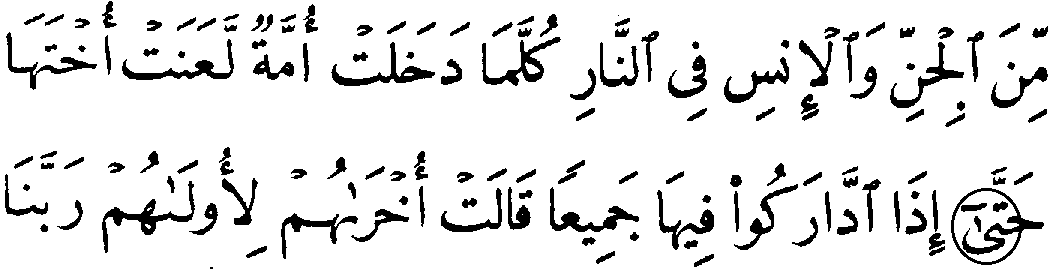
Part 2: The True State Of The Qur'an CHAPTER XIII (Cont'd.) Back To Main Index "Again, in thousands of cases it [alif] is not written, although it is fully pronounced (for instance ought to have been written
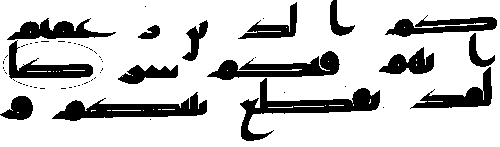
Thus, this new sign is used to mimic consonantal symbol alifs in order to make up for thousands of missing ones which "ought to have been written" and werent, as is evident in the inconsistent spelling mistakes we will note. This method does not replace the alifs into the graphic form, but in a manner which is mistaken by some as original Quranic Arabic.9 The following Note IX from p. xxxi of the 1938 Hyderabad printing of M. Pickthalls translation and an Indian-ised 1924 Royal Cairo Edition confirms this. The dagger alifs (small alifs) are marked with arrows:
Although the dagger alif is also utilised in some cases in modern Arabic it is not part of original Quranic script. Islam has happily used it these so-called small alifs to correct various types of shortfalls in the original - the true Quranic Arabic. It is important to note, then, that while Bilal Philips introduces some spelling mistakes which require this type of correcting. He also attributes them to the work of Uthmans scribes: "The Quran is essentially an oral revelation 10 written down according to the Arabic script known to the Prophets (PBUH) companions. Even the peculiarities of the scribes responsible for transcribing copies of the Quran made during Caliph Uthmans reign (644-56 C.E.) have been preserved to this day since Muslim scholars down through the ages have unanimously agreed to follow the basic structure of the "Uthmanic" transcription when making new131 |

 ). For printing the Quran they have invented a new sign, a small alif, which is marked just above the letter which this alif is to follow, and the difficulty is removed." (Orthographical, p. 78; emphasis added)8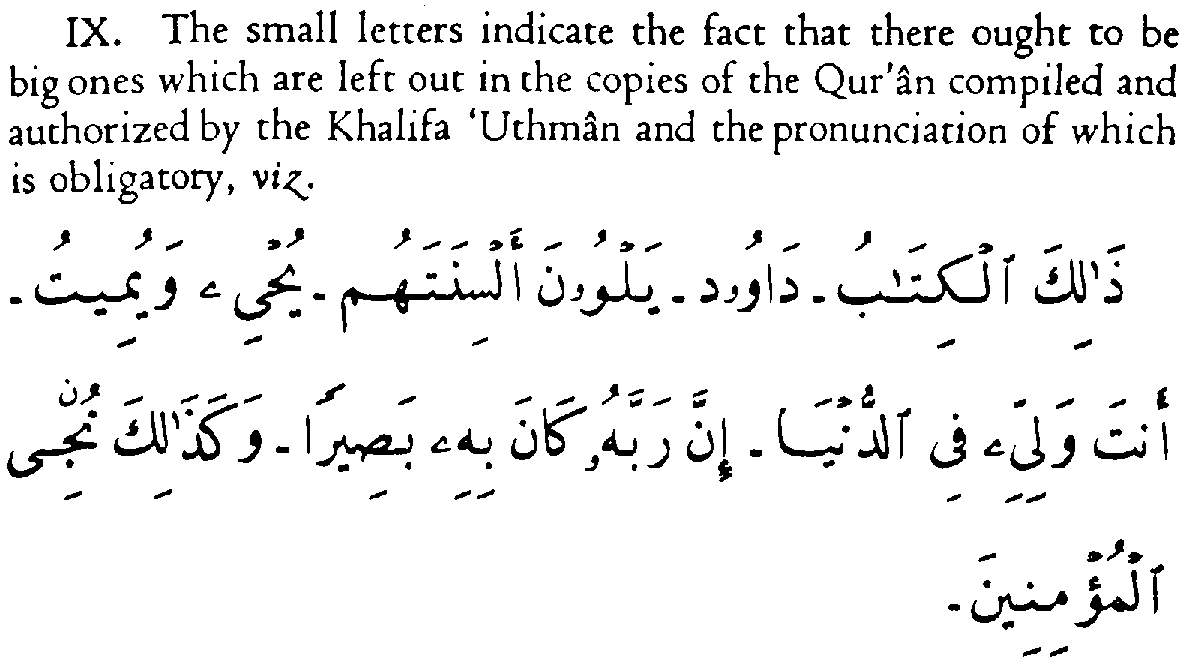
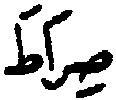 and give
 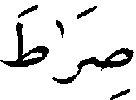 the same sound and the same meaning, the one is a corrected graphic form and the other has been fixed with the new invention. Something was absent from the original. The reasons for such absence, we will see, is varied.
 |
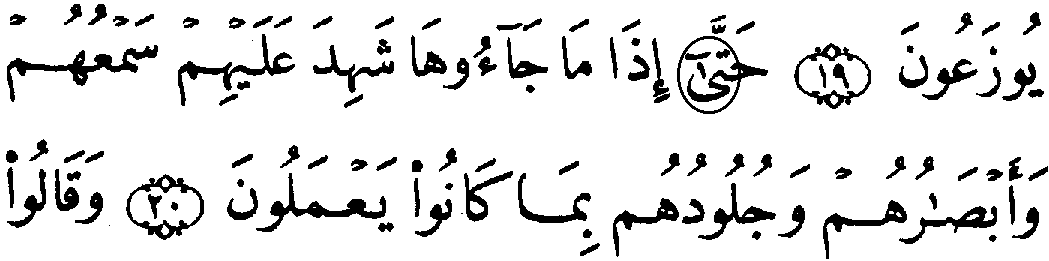
Part 2: The True State Of The Qur'an copies of the Quran. Consequently, among the peculiarities of the Quranic script existing to this day are Alifs ( ( 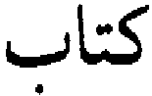 ) and at other times not ( ) and at other times not (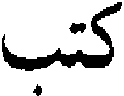 ). Similarly, the unpronounced Alif in the phrase "Bismi" is written in some cases ). Similarly, the unpronounced Alif in the phrase "Bismi" is written in some cases ( 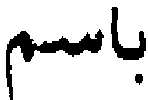 ) and not in others ( ) and not in others (  )." (The Qurans Numerical Miracle, B. Philips, 19 HOAX AND HERESY, p. 10). )." (The Qurans Numerical Miracle, B. Philips, 19 HOAX AND HERESY, p. 10).
Here Philips acknowledges the "sometimes written, sometimes not" peculiarities as being in the original "Quranic script" in Uthmans texts. While the Arabic language does have instances where letters are silent, what we are examining are original imperfections in a perfect text. In his footnotes he cites examples of the problems listed in his text: - alif is omitted in the word kitaab (book) in Q 20:52 and in Q41:3, while elsewhere the word is spelled with alif, for example in Q13:38 and Q18:27. - alif is omitted in the word bismi as in Q11:41 and in Q27:30, but has been included in other places, for example in Q56:96, Q69:52, and Q96:1. Thus, we must understand the missing alifs as spelling mistakes.11 We may therefore conclude that Philips has informed us that the Bismillah, the short sentence which introduces every Surah except for Surah 9, has in fact got 3 spelling mistakes in it. These include the alifs omitted from the words Bismullah, Allah and Rahman. In Philips words: "Similarly, the unpronounced Alif in the phrase "Bismi" is written in some cases ( Thus Philips concedes that 3 consonantal symbols are omitted (deleted?) from the very first line of the Quran, and when he counts the letters, he includes them among those that should be present. In light of the other admissions about the scribes of Muhammad, we can understand how they were deleted. Of course, it must be too embarrassing to admit spelling mistakes in the very first sentence of a perfect copy of a perfect Divine Quran, but surely the word "deleted" is an ineffective way to gloss it over. Yet in doing so, Islam admits that in this short sentence alone, which occurs 113 times at the beginning of all but one Surah, the perfect text of the Quran is missing 339 alifs. 132 |
 ), Yas (
 ) and Waws (
  ) written but not read as well as some that are read but not written. For example, the pronounced Alif in the word "Kitaab" is sometimes written
  Bismillaahir-Rahmaanir-Raheem (In the name of Allah, The Beneficient, The Merciful), there are 3 deleted Alifs, one of which is unpronounced (
 ) and (
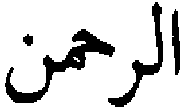 ), which make the total number of letters 22 and not 19." (19, Bilal Philips, p. 10f)
|
Part 2: The True State Of The Qur'an Back To Part 2 Index 3/ For Correcting THE Divine Name? Now, if we examine more closely the examples of missing alifs just cited above from Hamidullah (p. 78), we find in the first group the name Is it not absurd to believe that the Quran is an exact copy of a Tablet when this means that the name Allah wasnt spelled correctly there, or, that Muhammad and the scribes didnt actually know how to spell the name Allah? Surely this is evidence that those who were responsible for recording this exact copy were not of sufficient knowledge to spell the word for God correctly? In fact, Islam seems confused since the spelling of the word Allah can vary in the same Quran. For, while the Taj (as in the Swahili) text admits to the deleted alif and uses a dagger alif as a replacement ( Even in the 1938 printing of the 1924 Egyptian text they acknowledged in the Notes that they chose to spell the word Allah their own way, with a dagger alif:
This they followed in the text, for example in the Bismillah as in Q27:30 This also means that the 1924 Egyptian Edition has 2700 fewer dagger alifs than the non-Egyptian graphic forms examined here. And Ahmed Deedat, despite his booklet What is His Name? which admits these very spelling mistakes by using the dagger alif spelling for Allah, seems caught between the two spellings for not only was he selling this 1938 Hyderabad text, but he sells Qurans with all spellings. Yet he assures us that this IS "THE NAME" for the true God. 133 |
 [Allah], and, in the second group, its corrected form
  [Allaah]. Thus Hamidullah too admits that the word Allah is misspelled in the Quran.
 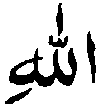 ), others, like the Egyptians, still unsure they want to reveal this, or simply unsure how to spell what they believe is the Divine Name, use a fatha (short a) (
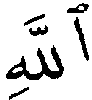 ). Perhaps it is in hope that the number of errors wont appear so great, or that one of them is correct!! Of course it is not desirable that there are 2,700 times12 in which the Quran has spelled the word God WRONG! Lest we forget, this accounts for 2700 of the very large number of alifs missing from the original Quran.
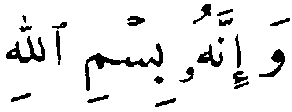 ). However, they didnt follow this spelling in each Bismillah which introduce each Surah
|
Part 2: The True State Of The Qur'an Back To Part 2 Index Despite his own indecision as to which version of the Bismillah is the true one, Mr. Deedat declares that the Christians are "stealing" it and placing it at the beginning of their Quranic style Gospel because it is "inimitable". But which spelling is "inimitable"? He writes: "The Arab Christians who boast a population of 15 million today, not to be outdone, have produced the Christian gospels in Quranic style. They have plagiarised the Holy Quran by stealing words and phrases and even the style, not even forgetting the Bismillah. Every chapter of their modern invention begins with the first verse of the Quranic Revelation. You have to see it to believe it. Here is a photostat of the new man-made "revelation"....Here is another proof, if proof was needed that the Quran is inimitable. Try as you might. The challenge still stands." (Al-Quran The Miracle of Miracles, p.71f) One would normally be at a loss (i.e. bewildered) finding Mr. Deedat admitting that something which contains spelling mistakes, like the Bismillah, is part of Islams inimitable revelation. However, since he has, and has also accepted the new man-made "revelation" called the Mushaf al-Madinah as Quran, one cannot justify his outwitting wherein he accuses the Christians of having a new man-made revelation, when all they have done, is copy the Quranic style. The truth is, as we are beginning to see, that it is the Quranic Style which shows the touch of man. This particular Gospel has only been "made to appear" so. 4/ Not part Of Quranic Script Another example of spelling mistakes given by Philips concerns the word man (insan) in Q96, and it is evdefinition of "Quranic script" for even in his examples where a dagger alif has been added as a restorative measure, Philips still admits that the word is written "without alif" because of its absence in the original texts, the only place where one finds true "Quranic script". He states: "The first part of the statement is correct; the word Insan One need only examine this example in the Indian/Pakistani group of Qurans (Arabic) to notice that Philips is correct, and they have made a full correction by actually inserting a consonant alif into the graphic forms of their Qurans. Obviously this is like the Ottoman Turk attempt, but we 134 |
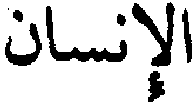 is written as
 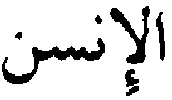 , without the Alif, in the oldest manuscripts of the Quran and also in Qurans printed in the Arab world, while the Qurans printed in India and Pakistan include this particular Alif based on their old manuscripts." (19 , p. 22).
|
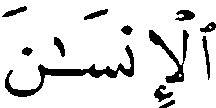
Part 2: The True State Of The Qur'an Back To Part 2 Index find that indeed Pakistans oldest manuscripts show evidence of correcting of spelling mistakes. However, it is inaccurate to present Yet what we have just seen represent but a few of the 1600 graphic alifs in the Pakistani/Indian texts which are dagger alifs (i.e. admittedly missing alifs) in the 1924 Egyptian text. And these 1600 graphic alifs are but few in comparison to the 5300 graphic alifs in the Turkish text. We ponder the reason that there is a difference of 3700 correcting alifs between these texts.13 But, while Philips asserts that such missing alifs are "peculiarities of the [original] Quranic script", evidence of the peculiarities [spelling mistakes] of Uthmans scribes, Ibrahim Surty is reluctant to admit this, and proclaims even the dagger alifs as part of the "Quranic script". And so he defines them under "Long Vowels": "For such a long vowel in the Quranic script both alif [ So he supplies a different definition of "Quranic script", one which suddenly includes the new sign of the dagger alif, something that is used to replace graphic alifs that were missing from the original script. Even Von Denffer tries to present the dagger alifs as part of the original Quranic script. He writes: "Numerous copies of the Quran were made after the time of the Prophet Muhammad and the Rightly-Guided Caliphs, and the writers of these manuscripts strictly observed the autography of the Uthmanic Quran. There are, compared to the usual Arabic spelling, some peculiarities. Here are a few of them, only concerning the letters alif, ya, waw, by way of examples.14 - The letter alif is often written on top of a letter instead of after it, e.g. Perhaps he would like to show us the original text which contains this dagger alif? It is this type of dishonest representation that makes the Quran look perfect even when there are obvious imperfections. And, after accepting such a teaching, who would think anything of finding that in Q20:63 the Indian (and Taj) text has only dagger alif 135 |
 .
.  ] (This short Alif is also known as dagger Alif.) are placed on the consonant which carries fathah." (Quranic Arabic, Surty, p. 60; emphasis added)
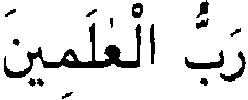 ." (Ulum, p. 60; emphasis added).
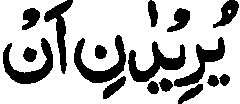 while in another Hafs text, namely the 1924 Egyptian, there is a graphic alif
 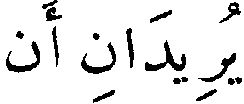 . Since the Medinan (Warsh) text also has dagger alif
 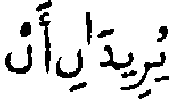 , we again find evidence that the Indian and Pakistani Taj (as in the Swahili) texts bear
 |
Part 2: The True State Of The Qur'an Back To Part 2 Index the graphic form of the Medinan (Warsh) text. How did this corruption happen? We conclude that certain groups within Islam would like the presence of the dagger alif to pass uneventfully, and it matters not to them if some happen to think that it is part of the original Quranic script, part of the orthography of the Uthmanic texts. In fact, that would be beneficial to the illusion. Although it is "made to appear" original, the dagger alif was never written on top of a word in the original Quranic script. Now there are something like 10,000 of them! It is no wonder that a Malaysian lady looked incredulous when she was told of Hamidullahs admission that the dagger alif is not original. She had thought it was - and that the Quran was complete and perfect. 5/ Numbers And Placement Differ In The Hafs And Warsh Texts We are not finished, though, for if one examines more extensively the Warsh (Medinan) and Hafs (Kufan) texts one finds that they do not always contain dagger alifs in the same places, indicating that they serve other purposes than merely correcting spelling mistakes. This is evident with Yusuf Alis example of two readings for Q47:4 of which he states: "There are two alternative readings, (1)15 But, we note that the reading Furthermore, in spite of Yusuf Alis plea that "The meaning of the first reading is wider, and includes that under the second.", the fact is that the one declares the reward for martyrs, while the other declares the reward for all who fight, a much broader group. In Islamic theology this is making a statement which Allah didnt make. Another example is from Q2:9 as given by Von Denffer. He writes: "Read the two versions of Sura 2:9 given on plates 7 and 8. Disregard the difference in style of writing. The first example is from a Quran from North Africa, the second from a Quran from Jordan. In the North African version, the word 136 |
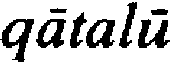 , "those who fight", and (2)
 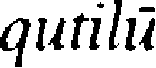 , "those who are slain". The meaning of the first reading is wider, and includes that under the second. I have translated on the basis of the second reading, which is in accordance with the text of the Royal Egyptian edition." (The Holy Quran, King Fahd, 1410, Footnote #4824)
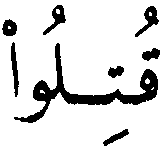 ), that of Hafs, sticks to the text of Uthman, while
 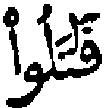 ), that of Warsh, has been obtained by adding a dagger alif, and thus extending (adding to) the text of Uthman one alif.
  (they deceive) is used twice, while in the Jordan version, the word occurs as
  in the second instant. Both
|
Part 2: The True State Of The Qur'an Back To Part 2 Index are correct and accepted readings, since they have been transmitted to us. Also there is no objection from the viewpoint of grammar or correct language and the writing without vowel signs can carry both readings." (Ulum, p. 113; emphasis added) Of course, the first objection is that we have seen just how uncertain has been the way these accepted readings "have been transmitting to us" and that Islam has no certain knowledge concerning them, let alone concerning those readings it asserts belonged to the original 7 Forms. The next objection is that the assertion that "the writing without vowel signs can carry both readings" is a misdirecting of the mind away from the purpose of a dagger alif, which is to extend the existing consonantal symbol text. In this way it is implied to be nothing more than another vocalisation when it is not. All this is a deceitful outwitting. Finally, we must raise the importance of why it is necessary to state "there is no objection from the viewpoint of grammar and correct language" when it is asserted that the Quran is an exact replica of "Allahs Words"! Surely God has no problems with His Arabic?! The truth is that here in Von Denffers own words we find a repetition of the rationale which we found in as-Suyutis citation from ibn al-Jazari. It is the anything remotely close to Arabic grammar, and remotely close to an Uthmanic text although "even if only in some way" or "even if only probable" which makes anything transmitted to us acceptable, even though the text is being altered and contorted to fit it. But, admits Von Denffer, this is why the Uthmanic text of Q2:9 is acceptable in an altered form. But ibn al-Jazari went further stating: "...but when one of these three conditions is not fulfilled, it is to be rejected as weak (daif) or exceptional (shadh) or void (batil), no matter whether it is from the seven or from one who is older than them." (Itqan, Suyuti, I, p.75, as cited by Von Denffer, Ulum, p. 120f; emphasis added). It stretches ones credulity to the utmost to believe that a Quran is perfect which has been assembled from an assortment of materials which is of such low quality that it has to be far worse than "remotely close to Arabic grammar", ETC, before it is rejected! Surely this is not the perfection we are told Islam possesses. So far we have seen some obvious spelling mistakes, extensions to the consonantal symbols of the text to accommodate the new readings, and acceptance of things "remotely" like Arabic. But there are other matters. 137 |
|
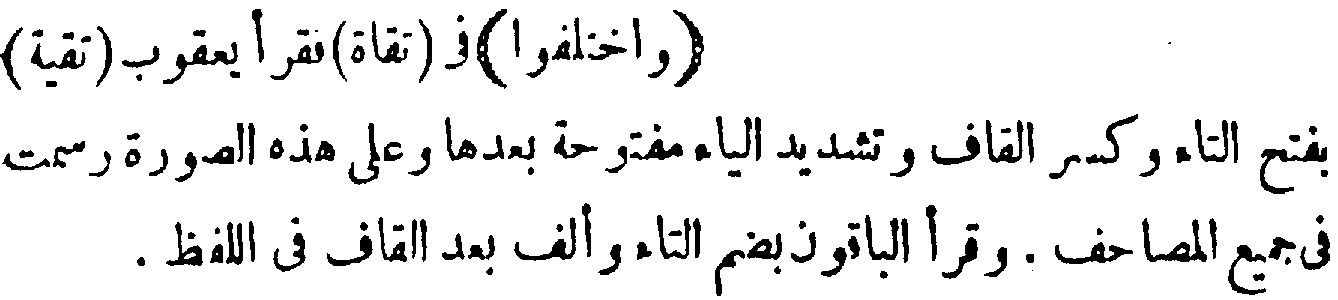
Part 2: The True State Of The Qur'an Back To Part 2 Index 6/ A Dagger Alif Is Not A Ya-Alif In the Arabic language there exists the possibility of treating a ya as either a consonant y or as a long a, in either case the graphic ya remains. It is a y if the two dots are included underneath the ya .16 It is pronounced as a long a if the two dots are omitted, or, in the case of the Quranic Arabic, if a dagger alif is placed above the ya. This is referred to as a ya alif. 17 However, in Quranic Arabic there is a third choice, for the presence of a dagger alif above a ya many times indicates to the uninitiated reader that the graphic ya is being replaced by an alif.18 In each of the above three cases the meaning of the text varies considerably, and this is the importance of finding that the new readings disagree with the texts as to whether there should be a ya of either sort, or an alif. A statement from ibn al-Jazari on Q3:28 makes it clear that the accepted oral text differs from the accepted graphic form of Uthman: "Yaqub read taqiyyhtan, which tallies with the shape of the graphic form in all the written texts. The other nine read tuqAhtan in accordance with the oral text." (al-Nashr, Vol. 2, p. 23919: emphasis added). The Arabic text of this is:
A different meaning results as the following show. - Yaqubs reading, using the ya as a y and doubling it, produces the meaning "righteous one". - The 9 replaced the ya with an alif, giving the meaning "righteousness". Such a reading is indicated also by the retaining of the two dots on the ta marbuta ( - A true ya alif would give the meaning "righteous ones". In this case the two dots would also be missing from the ta marbuta.
138 |
 which disagrees with the Uthmanic graphic form, although, in the 1924 Egyptian Edition it is not obvious as it has the same configuration as a ya alif
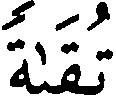 20 - a dagger alif above the ya stem and no dots. However, only Yaqub chose to use the content of the Uthmanic text and so has a consonant y in his reading.
  ).
).|
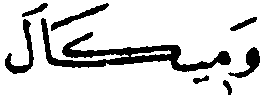
Part 2: The True State Of The Qur'an Back To Part 2 Index The reading of the 9 has been obtained at the cost of rejecting the content of the Uthmanic graphic form. The acceptance of both readings definitely shows Islams lack of adherence to the Uthmanic texts, or even to one original reading, or one original MEANING. Such a rejection stands out also in cases where a text appears to have a ya alif, but in another text we find it has been converted right into the graphic form as an alif, thus indicating the true purpose. For example in Q2:98 the Turkish (and Iranian) text contains an alif in the graphic form 21 , whereas the 1924 Egyptian text has only a dagger alif above an unmarked stem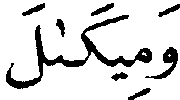 . .
Here, then was another reason for the Egyptians to make a new text22 and restore the Uthmanic graphic form, even though it would indicate the conflicts between the Oral Tradition and the text. [See page opposite for examples where the Samarqand MSS replaced the ya with alif.] Here is Proof that even the "most ancient manuscripts" of Islam show signs of tampering by the later scribes. They knew they had to reject the Uthmanic Text (graphic form) if they were to accept the "best transmitted and most reliable" readings - things like that of Hafs and Warsh. Surty also includes examples of pseudo ya alifs under additional loops. When writing in this same section on "Quranic Orthography" he writes: "Certain words include an additional loop ( Among Surtys examples of additional loops [see at right] we find #9 the word bi-aydin [Q51:47] - note the extra Uthmanic ya has been ignored - even though ibn Khaldun spelled it with two yas as biayydin, and classed it as evidence of the lack of knowledge of Muhammads scribes. Hamidullah termed this the only case where one too many consonants was found in the Quran. 23
139 |
 ) in Quranic script which stands for the consonant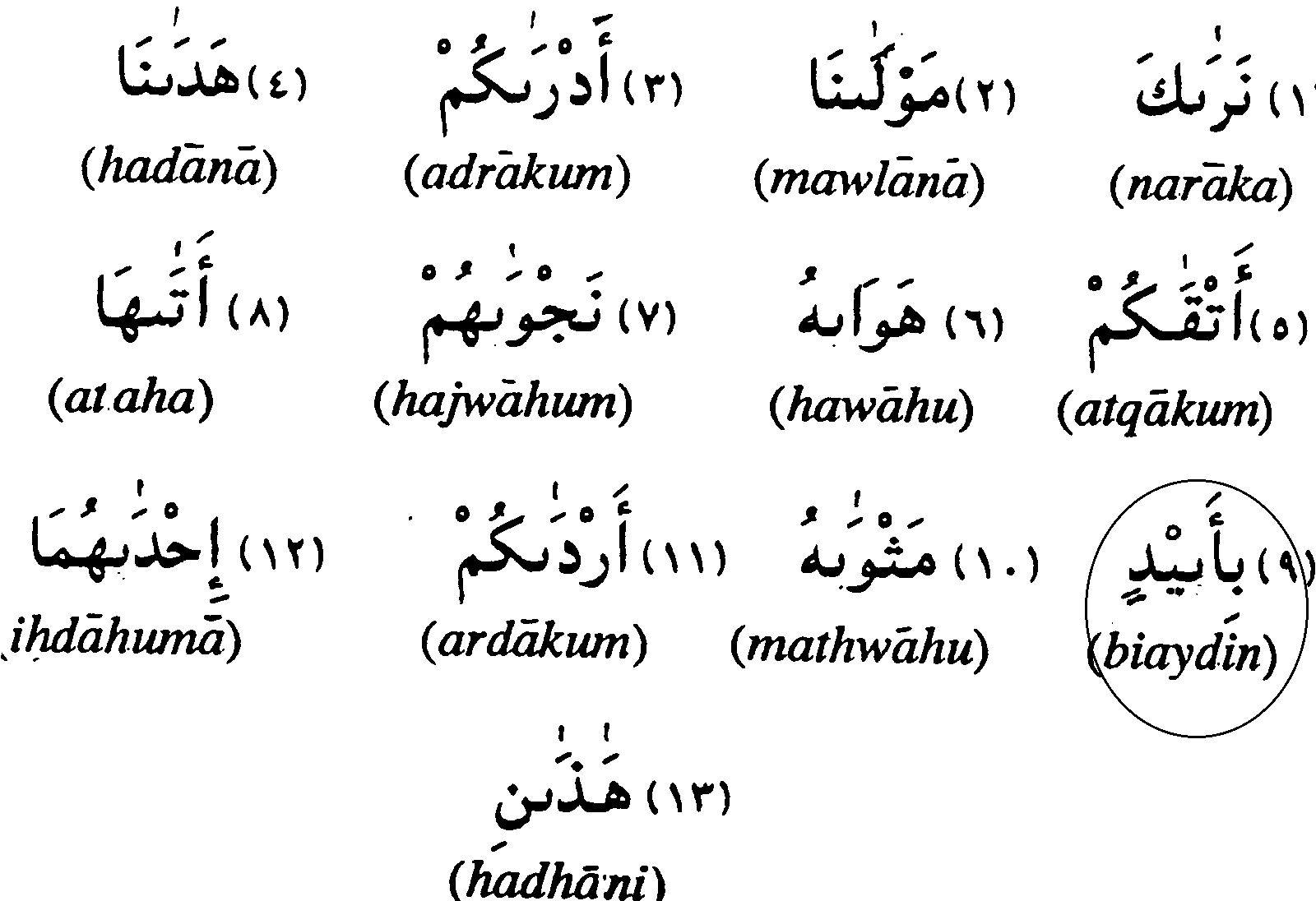
|
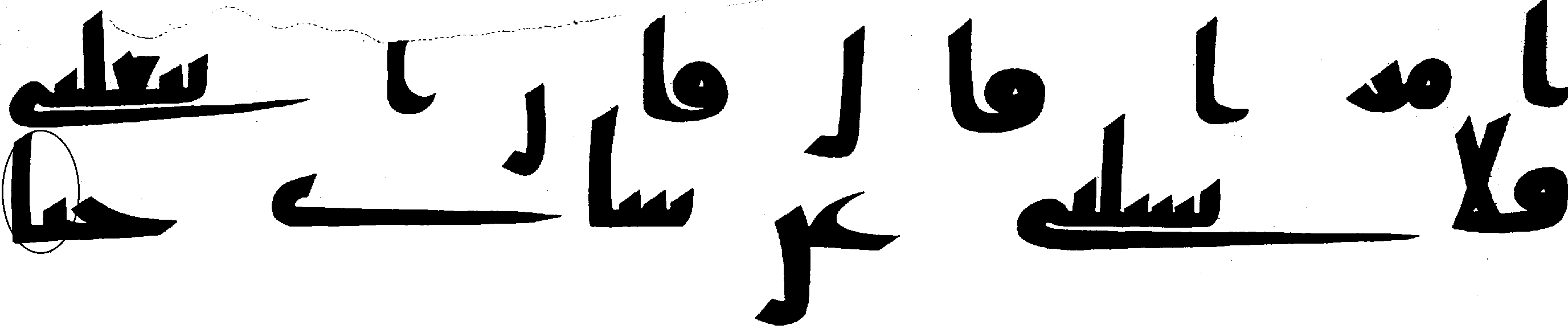
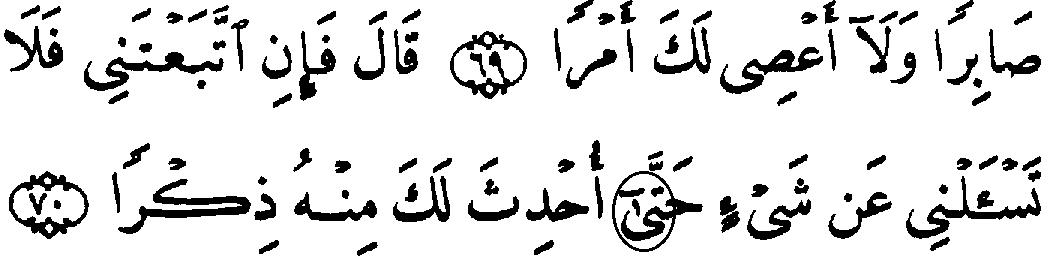
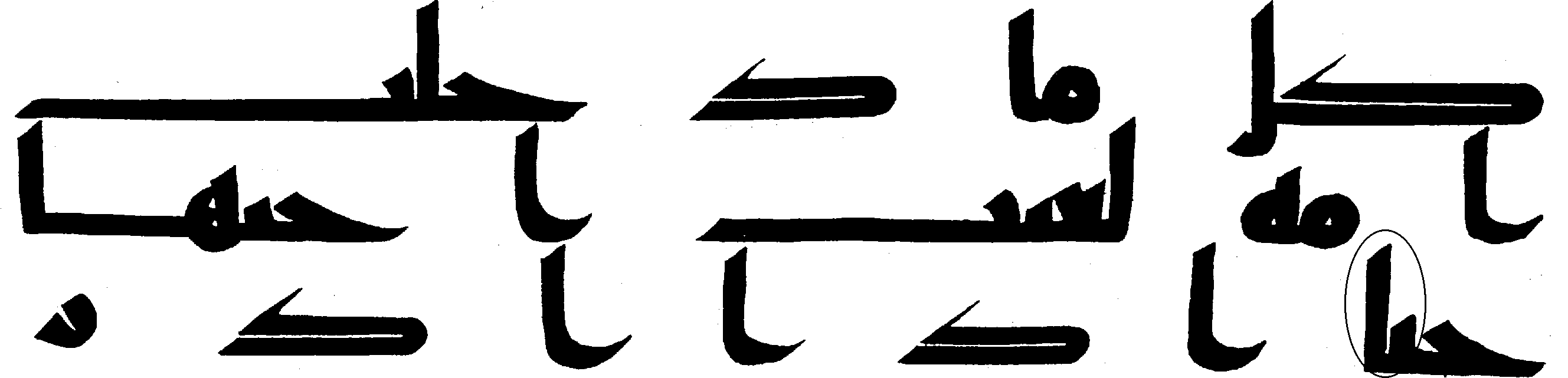
Part 2: The True State Of The Qur'an Back To Part 2 Index Page #692: Q41:20 Ya overridden by alif.
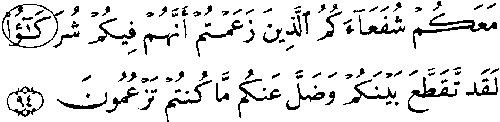
Page #518: Q18:70 Ya overridden by alif.
Page #350: Q7:38 Ya overridden by alif.
Page #297: Q6:94 Waw overridden by alif.
Back To text 140 |