|
Part 2: The True State Of The Qur'an CHAPTER XIII (Cont'd.) Back To Main Index c/ More Playing With Uthmans Graphic Form - The Shadda ( (1) To Extend The Text It is noteworthy that, as with the dagger-alif, the shadda is used massively to extend the consonantal symbol texts. We earlier noted the difference of yartadda It must recognised that the shadda is not part of the original Quranic Arabic, but is a later addition. It tells the reader, The Oral Tradition indicates that the reading has 2 dals, but the text only has one, so the `Uthmanic consonantal symbol text has been extended in order to use the reading". Clearly its purpose was not to make the texts uniform, nor to produce the same reading since this reading could not have been obtained if the graphic form already had 2 dals.24 In Q2:79 alone we find five shaddas in the 1924 Egyptian which are not in the 1909 Turkish text. Thus, in this aya alone the Egyptians now have five consonants more than they had been using for years.25 Again, in some cases shaddas have been used on both the Kufan and Medinan texts although both texts contain the same consonantal symbol. As one example out of a mass of such occurrences we note that in Q2:54/55 the leading stem, used as a nun, has a shadda on it in both the Warsh The first nun is deliberately ignored because the reading has required 2 nuns in a row with no short vowel separating them. The `Uthmanic graphic form as it is cannot achieve this since grammatical rule demands that each consonant be assigned a short vowel or quiescence, which, in both our instances would separate the 2 nuns thus disallowing the use of the new reading. Therefore, the scholars have used the shadda to manipulate the text. 141 |
 )
)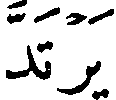 / yartadid
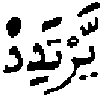 (Q5:54), where the Warsh reading yartadid used the 2 dals in the Medinan graphic form of `Uthman as they were. The Hafs reading, however, has not simply used the existing single dal to obtain yartadda, for although no second dal has been inserted into the Hafs (Kufan) texts graphic form as a means of making the texts "the same", in real terms a second dal has been added because a shadda (
 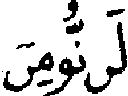 and Hafs
 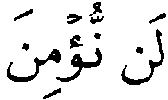 texts. The purpose is obviously not to unify the texts, as they were already in agreement, each having 3 nuns. The first 2 are side-by-side in the graphic form. But, an examination of the transliteration of this text shows some tampering. Whereas 4 nuns in total are called for (one extra by the shadda), the transliteration has only 3 (lan-numina) - it is one of the graphic nuns which is ignored!
|
Part 2: The True State Of The Qur'an Back To Part 2 Index Where is the one original reading that fits the text without tampering? Then we come to the cases like Q2:247 (Hafs)/245 (Warsh), where the Hafs (Kufan) text has a shadda doubling the ya The shadda is obviously used for the purpose of extending the original consonantal symbol texts to allow the new readings to be used. We also note that the numbers of shadda are in no way uniform between the Hafs texts, let alone between the Hafs and Warsh texts, so they can not be counted in the manner that Allamah Rizvi has tried to portray: "Letters and Wovels (sic) counted: How much care has been devoted by Muslims to safeguard the Quran from any possible alteration may be seen from the fact that they counted not only the Ayats and Ruku, but every single letter of the alphabet; and every single sign of wovel (sic) has been meticulously counted and recorded. For example, we know that there are 48872 We must assume that the Allamah, who inserts the term Seyyid in his name thus declaring his descent from Muhammad, feels he is free to use the freedom the Shiah attribute to him, namely Kithman/Taqiyya/Tauriya. One must assume this for he lives in Dar es Salaam, Tanzania where one version of the Taj (Hafs) text from Karachi is used in the Swahili/Arabic Quran, and in that version one finds some 1660 shaddas (tashdid) more than is in the 1975 Islamic Foundation (83 Amana) text26, being for the most part the Egyptian (Hafs) text, also freely available in East Africa. Perhaps he should try counting the shaddas (and everything else) in his Quran again? But, with regard to the reasons the Egyptians rejected the Turkish text, the 1924 pure Hafs Egyptian Edition contains some 3380+ more shaddas than the Turkish text! 1370+ in Q1-12 alone despite Allamah Rizvis total. And, since those in the Turkish text do not always match those in the Taj text, no wonder the Egyptians felt it necessary to publish a new text and reject ALL printed ones. Since Allamah Rizvi, being Shia, obviously follows the reading attributed to Ali, the son-in law of Muhammad, and the isnad in the 1924 Royal Cairo text has explicitly mentioned Ali in the chain of transmitters, perhaps Allamah Rizvi will let us examine the version of the Arabic Quran that he uses. Its content is quite different from the Sunni version. What we have seen is no small matter, since, as already noted, every one 142 |
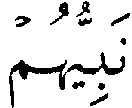 but the Warsh (Medinan) text has retained the single ya
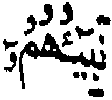 .
.  [i.e. alif] and 11428
  [i.e. ba] and so on. Also we know that the Quran has 53243 Fatha (
  ) [i.e short a] and 1258 Tashdid (
|
Part 2: The True State Of The Qur'an Back To Part 2 Index of these shaddas means that another consonant has been added to the original number of Caliph `Uthman. 3380+ extra consonants added to the Turkish to make the Egyptian text, ...ETC.. And, also declared by the presence of all these shaddas is the evidence that Islam has been using hodge-podge versions, a mixture of readings. A few out of the multitude of examples follow. In Q2:100 a shadda doubles the nun in the Warsh text In Q2:261 we find a shadda doubles the ya in the Warsh text Near the end of Q2:107 we find the 1924 Egyptian with 1 shadda In fact the 1924 Egyptian Edition contains some 1670+ shaddas in Q2 alone. The Turkish having 258 in Q2 thus has 1667-258= 1419 shaddas less in Q2 alone!! The 1924 Edition has some 4660+ in Q1-5 only. Since this is close to 20% of the Qurans text, there may be some 23,000 shaddas in the 1924 Edition, but only 23,000-3380 = 19,620 in the Turkish text. Yet every shadda represents an additional consonant, an instance where the new readings have denied the canon of the consonantal text of `Uthman. Where is the reading which agrees with `Uthmans 1 Form? WHY did Allamah Rizvi proclaim "1258 Tashdid ( (2) To Alter The Meaning Perhaps the example which will illustrate just how much the meaning can be altered by the addition of a shadda is that which we just noted from Von Denffers orientalist source, John Burton, the case of yathurna or yattahirna. Here the reading yattahirna has been obtained simply through the use of a i. The result is a completely opposite meaning to the reading yathurna which was obtained by using the Uthmanic text as it is (the word structure occurs twice in Q2:222). Of this difference it was stated: "Two opposing doctrines: ...the permissibility of sexual intercourse with the menstruating woman at the expiry of her period but before she has cleansed herself, and the contrary doctrine, according as they 143 |
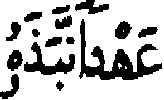 as also found in the Taj
 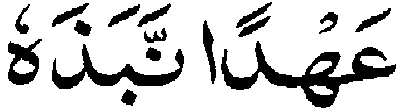 and Indian
  texts. However, the 1924 Egyptian omits it
 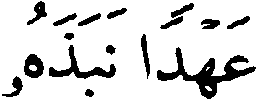 as does the Turkish
 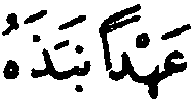 . This indicates a mixture of readings in certain texts purporting to be Hafs texts.
 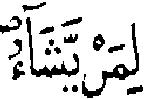 as also in the Taj (as in the Swahili)
 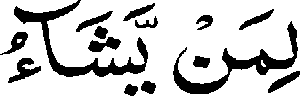 and the Indian
  . However, the Turkish
 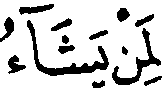 and the 1924 Egyptian
 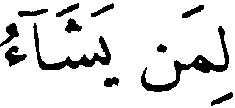 are without it. Again, an indication that certain Hafs texts contain a mixture of readings.
 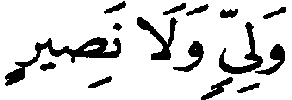 ), the Pakistani Taj (as in the Swahili) with 3 shaddas
  ), and the Warsh with 2 shaddas (
 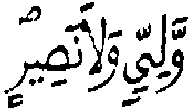 )!
)! |
Part 2: The True State Of The Qur'an Back To Part 2 Index read either yathurna or yattahirna." (Collection..., p. 36; emphasis added) Another example of altered meaning what is the consequence of such additions through the use of shaddas is the case of Q3:37 where the only difference is that the Hafs reading employs a shadda on the f in "Finally, the differencewakaffalahA / wakafalahA (Q. 3/37) is a matter of the stem and subject. The second stem reading signifies that God appointed Zakariya to look after the wife of `Imran, whereas the first stem reading signifies simply that Zakariya looked after her." (Value..., Brockett, p. 38) A considerable difference in any theology! The present English translations, all being of the Hafs text, thus denote, "that God appointed Zakariya to look after the wife of `Imran". But we need to recognise that this Hafs reading represented a new meaning, something which was derived from a reading which was not in total agreement with the `Uthmanic texts like an original reading would have been. How many others throughout the Quran have been new meanings also obtained in such a fashion by the acceptance of new readings for `Uthmans 1 Form? While Islamic accusations that the Bible is being altered are made simply because the English translations have slightly different wording, we find here masses of actual new meanings. These resulted because no original ARABIC reading that fit the text existed [or was accepted] and so new readings requiring tampering of the `Uthmanic content through the use of shaddas were used. We note that the Warsh reading didnt tamper with the text, and so perhaps it might be considered original. But, if that is the case, then in terms of Islamic understanding Islam has strayed far by attributing to Allah the appointing of Zakariya, something the untampered text does not attribute. Most use the tampered text. Although these meaning differences became incorporated into Islamic theology as legitimate, they cannot be proven to be original. (3) For Correcting THE Name Of God With regard to the name Allah, we remember that Bilal Philips admitted: "Thus in the opening statement of the Quran, 144 |
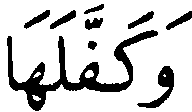 and the Warsh does not
 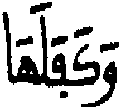 .
.  Bismillaahir-Rahmaanir-Raheem (In the name of Allah, The Beneficient, The Merciful), there are 3 deleted Alifs, one of which is unpronounced (
  ) and the other two pronounced, (
 ) and (
 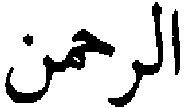 ), which make the total number of letters 22 and not 19." (19, Bilal Philips, p. 10f)
 |
Part 2: The True State Of The Qur'an Back To Part 2 Index And while we also remember that Hamidullah was bold enough to also admit that this meant it should have been written Yet, we search the translations of the Quran in vain for even one instance where it is spelled this way. And, even the transliterations fail to reproduce it. How, then, can we assess Maududis claim that: "In Arabic the word ilah means one who is worshipped, that is, a being which on account of its greatness and power is considered worthy to be worshipped: to be bowed to in humility and submission. ...The word Khuda in Persian, Deva in Hindi and God in English have similar connotations. Other languages also contain words with similar meaning. The word Allah, on the other hand, is the essential personal name of God." (Towards..., p. 63; emphasis added) The truth is that Islams only Proof is the hypothesis of some that if the Quran uses an Arabic name this must reflect eternal truth. Not so. d/ Silencing The Surplus Waw - And More Hamza [glottal stop] is a legitimate consonant although if unseated it is said to be vocal. However, there are places where the claimed `Uthmanic graphic forms differ concerning which consonant is in the graphic form: "..the Warsh transmission in general has far fewer glottal stops [hamzas] than the Hafs transmission. There are nevertheless cases of the Warsh copy having a glottal stop where the Hafs copy has waw or ya." (Value..., Brockett, p.33). But we also find that certain of the original scribal errors are also eliminated by the use of a hamza. The case which ibn Khaldun mentioned of an extra waw in Q5:29 fits into this category: "There is, for instance, ...the addition of the w in What happened to this waw? It occurs at the end of Q5:29 and has been silenced/eliminated by the seating of a hamza on it. This occurs in all our texts - the Warsh Back To Part 2 Index 145 |
 we note that this name has yet another addition to it, namely a shadda over the lam
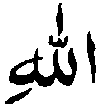 . This tells us that in fact there are two spelling mistakes in the word Allah, and that three lams 27 are desired which requires a spelling of Alllaah, not Allaah [or Alllah for those who dont want to admit the missing alif].
  "the sinners reward"..." (Muqaddimah, p. 442)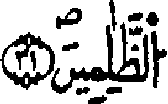
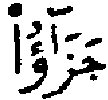 as well as the Hafs texts like the Egyptian
  the Turkish
  the Iranian
 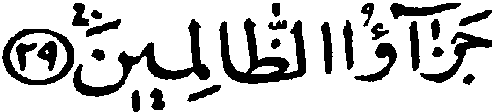 the Taj (as in the Swahili)
  the Indian
  and the Mushaf al-Madinahs
 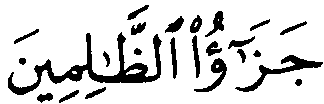 .
.