|
Part 2: The True State Of The Qur'an CHAPTER XIII (Cont'd.) Back To Main Index e/ More Silencing Hamidullah also notes many other cases where unwarranted consonantal symbols have been silenced. These are quite noticeable in the Egyptian text. In the case of the alif Hamidullah notes two reasons for silencing the Qurans text, the first of which we cited earlier: "In pre-Islamic days there was no uniformity in applying this superfluous letter at the end of certain plural forms, and its traces are found in the Quran where it is sometimes added to the singular also where it is not necessary according to the rule in vogue. But, as said, a "sign of silence" is marked wherever it occurs in the Quran and the absence in case of necessity has no bearing on the subject which we are treating, viz., how to read correctly." (Orthographical..., p.77; emphasis added) Thus Hamidullah provides more Proof for the assertion of ibn Khaldun that Muhammads scribes didnt actually know how to write well. This is also another clear "Proof against the declaration that the Arabic is of such high quality that it indicates a Divine origin. Hamidullah's examples include:
The 7th of these namely In the 1924 Egyptian Edition we find the last part of Q11:68 is Flugel lists the occurrences of thamUda, as can be seen at the right, on p.40. [again, his numbering system is different in some cases]. However, all are spelled without the alif indicating the correct spelling. Another case for silencing given by Hamidullah is: "Finally the same letter alif is written, I do not know why, in certain words of the Quran, and is absolutely unnecessary, and is completely silent in pronunciation. I refer to 146 |


 , is given 4 times in Hamidullah's List B where he has written
  after each of Q11:68, 25:38, 29:38 & 53:51.
  where the word thamUda appears twice. In the first instance, it has an excess alif as Hamidullah relates, and the "sign of silence" is plainly present thus "deleting" the excess alif on this singular noun
 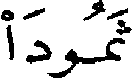 . However, in the second instance we find the word is spelled correctly as
 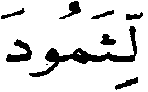 without the alif. In both instances the translation is "the Thamud".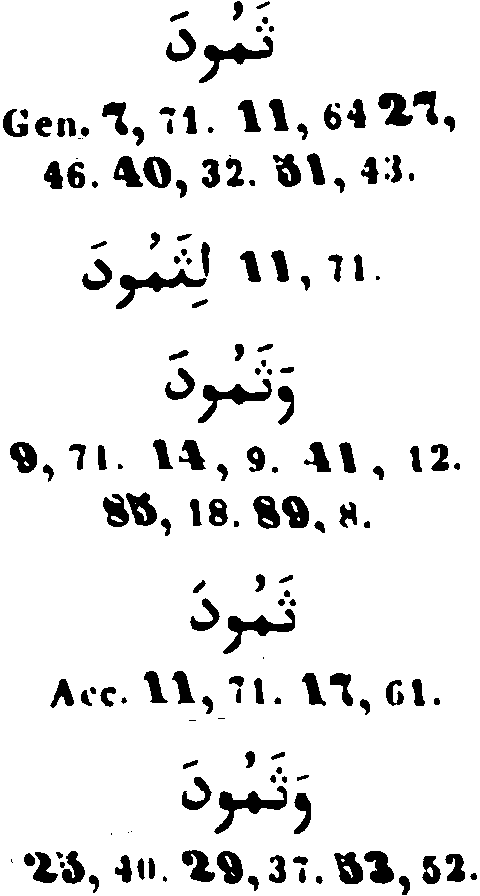

|
Part 2: The True State Of The Qur'an Back To Part 2 Index which ought to have been written28 No declaration of defense for these either. All are easily visible in the 1924 Royal Cairo as having been otiosed (silenced) by a tiny o above the offending letters, and, although noticeable in other texts, are most clearly seen in those which have followed the Egyptian text displaying their version of `Uthmans graphic form. As in keeping with his admission that these are excess alifs, when we examine 2 of Hamidullah's examples in his uncorrected list, namely Flugel lists them all only in the corrected form, the alif being removed, as can be seen from his text [p. 183 which can be seen at the right]. However, when we examine our printed Arabic texts we find no uniformity in the method of correcting these texts, not all admit that the excess alif is the problem, some indicate it is the ya. Take, for example, Q43:46, for which we list the various printed forms: -1924 Egyptian - Taj (as in the Swahili) - Indian - Turkish - Iranian - Mushaf al-Madinah - Warsh (Medinan) Thus while some are silencing the ya stem and ignoring the "superfluous alif", others are doing the opposite. There seems to be a great deal of guesswork going on behind the scenes. However, when we consider that it is the Egyptians who are claiming 147 |
 ." (p. 78, emphasis added).
 and
and  , and their corrected forms in his 2nd list namely
  and
and  , we find that an alif has been removed by him. This is confirmed also when we examine them in his List B, as
 , which is listed as being present in Q7:103; Q10:75; Q11:97; Q23:46; Q28:32; Q43:46, and as
  in Q10:83.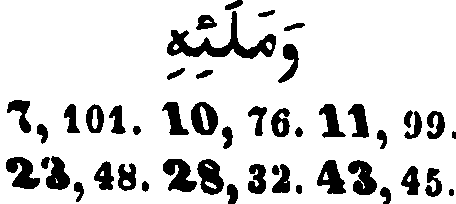
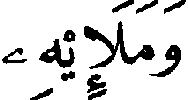 -silencing the ya stem and ignoring the alif.
 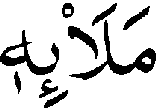 -silencing the alif and ignoring the ya stem.
  - another smaller Indian text (#147) is clearly
  .
. 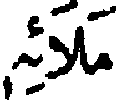 -ignoring the alif and silencing (with hamza) the ya stem.
  -as Turkish, ignoring the alif and silencing (with hamza) the ya stem.
 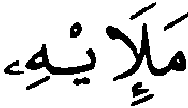 -as the 1924, silencing the ya stem and ignoring the alif.
 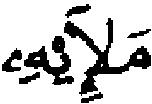 -as the 1924, silencing the ya stem and ignoring the alif.
 |
Part 2: The True State Of The Qur'an Back To Part 2 Index to resuscitate the Quran from the record of the Oral Tradition, we wonder why they didnt "silence" the superfluous alif? Perhaps it is because some 2,200 oitiosed alifs are already present in, for example, the 1990 Mushaf al-Madinah, which is also the number in the 1924 Egyptian text, and the Egyptians were unwilling to admit to many more and thus make it 2,200 +_ +_ ... ? What more can we add, except that one is again dismayed at Allamah Rizvi and his plea that: "every single letter has been meticulously recorded. For example we know there are 48872 But, does this take into account the approximately 10,000 alifs which have been added using dagger alifs to correct errors, or those included in the 2,200 alifs which have been silenced (effectively removed), or the 2700 which everyone is uncertain about in "the essential personal name of God" - Allah /Alllah / Allaah / Alllaah? It must be a Heavenly arithmetic that causes this to add up to 0 (zero), i.e. a perfect text. Even those who wrote the Samarqand original were busy trying to make it all add up to 0 [zero] since they too omitted certain alifs which the Egyptians silenced. [See Q2:94 on Page #30, line #5 seen at right].
f/ More Symbols Ignored Yet, we need also to subtract some other letters for while Hamidullah writes of bi-aydin (Q51:47) in his List B
In his List B we find he has listed Q5:89 and noted 148 |
 [alifs]"!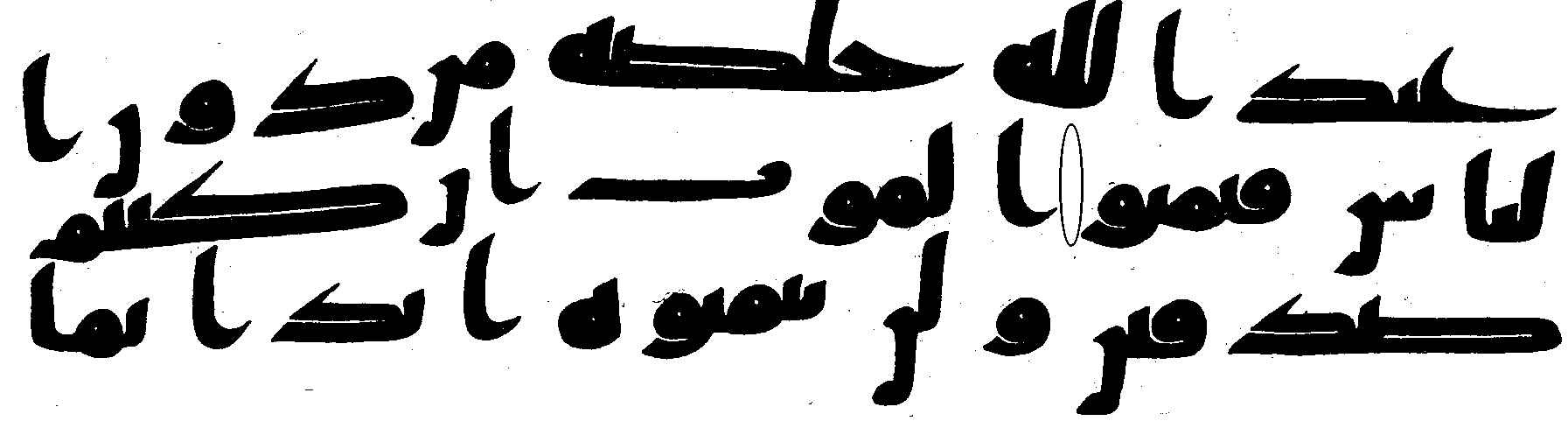
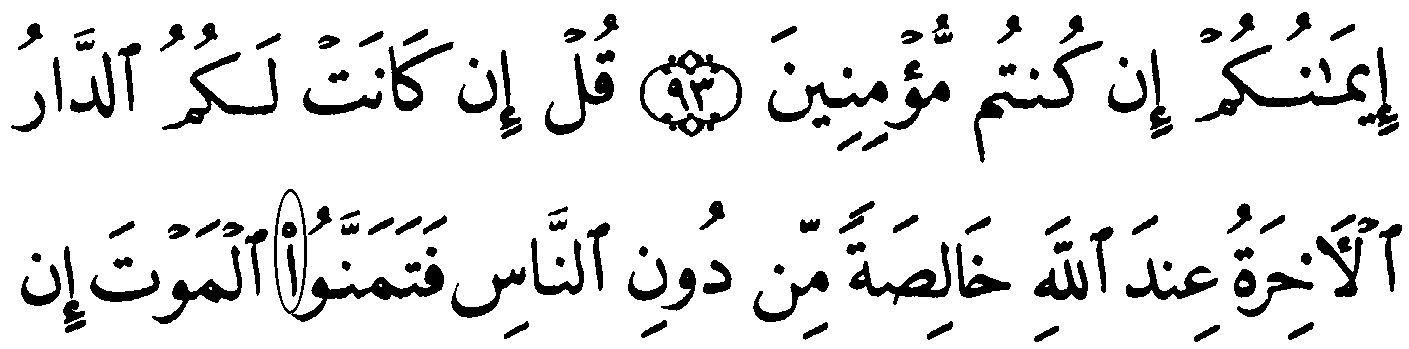
 , not only have we seen many other rare cases where alifs, etc, have been "superfluous", but Hamidullah also gives an example where an extra graphic consonant s is not silenced (otiosed), but is simply ignored.
  . True to his purpose, in fact it is not the qq that he is wanting the people of Islam to notice, for in his transliteration he has omitted the graphic letter dal, as also does the Indian transliteration with
 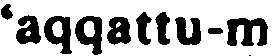 ! Even the 1924 Egyptian Edition with every sort of technique in full application has no sign of
 |
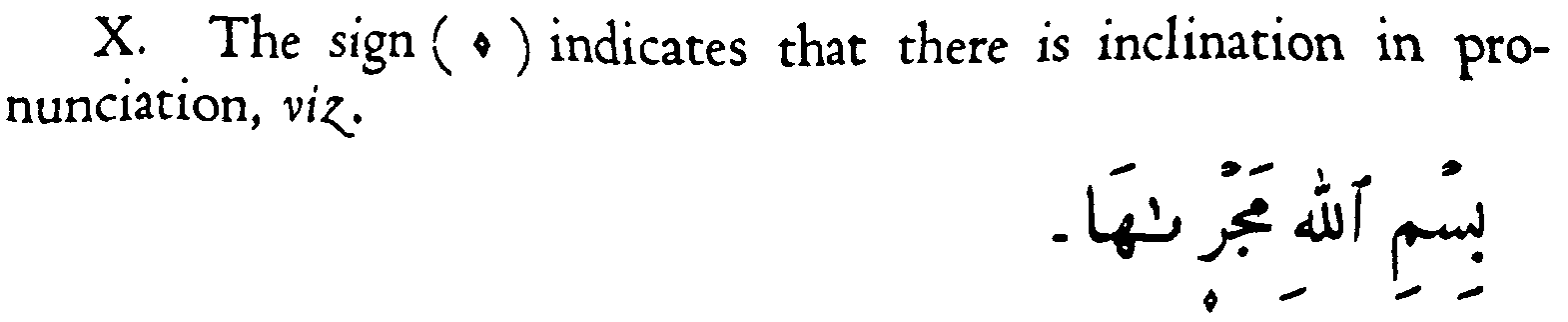
Part 2: The True State Of The Qur'an Back To Part 2 Index silence on this dal Ad-Dani also points us to a similar case where the text has an excess letter lam in Q6:32.29 He notes it should be indicating a single lam. However, the printed texts, including the 1924 Egyptian Edition (which claims to be founded upon ad-Danis records), have Again we see the consequences for Islam of not only having had to accept the corrupt `Uthmanic texts, but also the 7 new Readings which it admits are only "close to" the corrupt `Uthmanic texts. It has cost the Qurans perfection dearly. g/ A Strange Prounciation? Yet another case exists in which a strange pronunciation is not from the graphic form. The Note X to the 1938 Hyderabad text reads:
This particular example is Q11:41 which happens also to be one example in Hamidullah's long List B. There we find Hamidullah's transliteration and caution:
When introducing this "peculiar pronunciation" in his main text Hamidullah stated:
Indeed a "particular sign" is needed when ai is easily obtainable through the use of the correct letters, that is if the scribes had known how to write properly. As seen in Note X above the sign is But. is it after all a case of a peculiar pronunciation or a case of a new reading not matching the graphic form? NOTE: It is also important to understand, in this regard, that the usual Qur'anic texts do not have the 2 dots under the graphic 'ya' which Hamidullah has placed there. What is in the graphic form is NOT identified as a 'ya'. 149 |
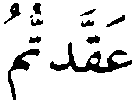 .
. 
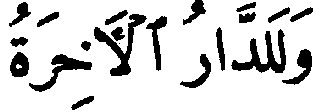 with 2 lams! This difficulty has been overcome by simply ignoring this graphic letter, as we clearly find in the Indian transliteration which has
 , only one lam is transliterated into
  .
. 


 .30
.30